Variable-Speed HVAC Pros and Cons for Costs and Comfort
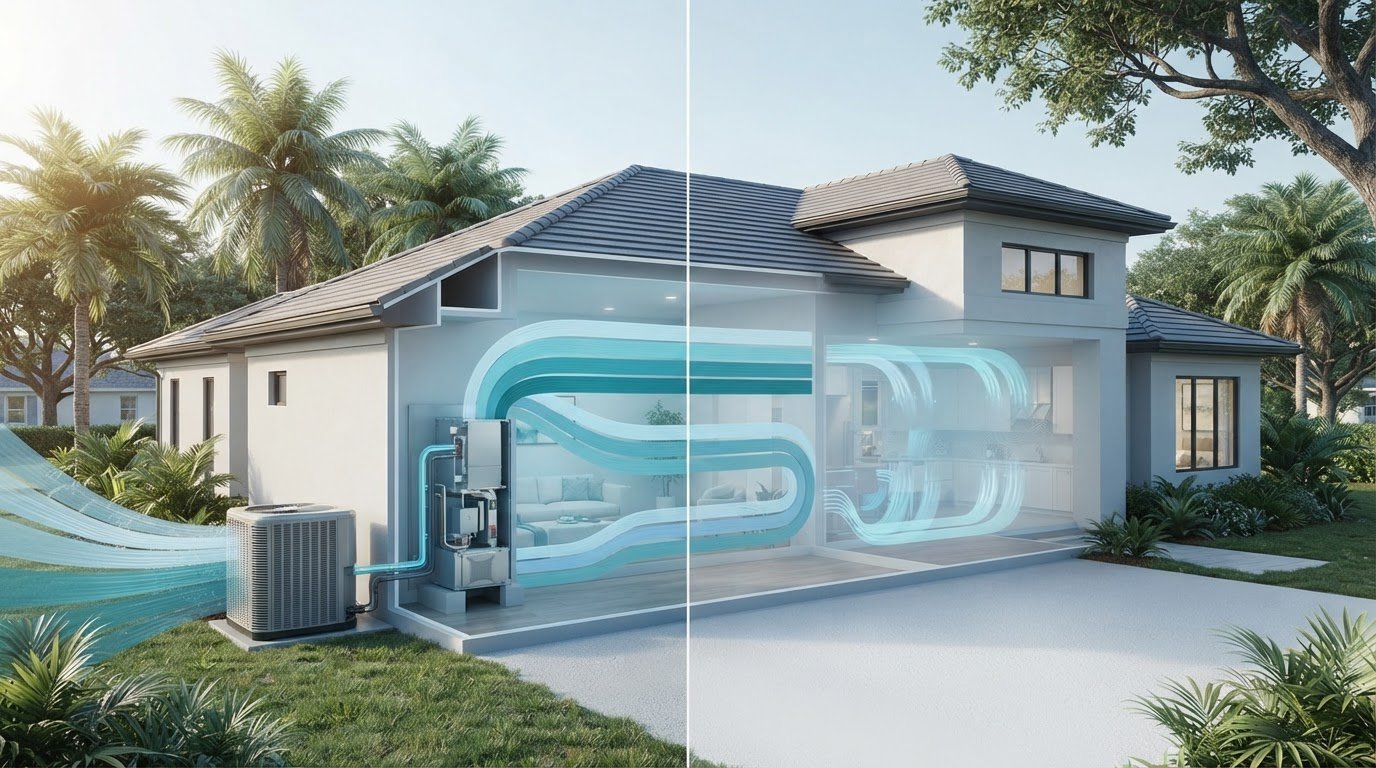
The most advanced air conditioner isn’t automatically the right fit for every home. Single-stage systems run at full capacity or turn off, two-stage systems switch between low and high output, and variable-speed systems adjust output across a range, often from 30% to 100%. The pros and cons of variable-speed HVAC systems depend on how much you value steadier comfort and humidity control compared with higher upfront equipment and installation costs.
Choosing between these options involves trade-offs: a simpler system may cost less upfront, while finer output adjustments can help keep temperatures more even and reduce on-and-off swings. The key is understanding how each system responds as your home’s cooling needs change.
This guide explains how single-stage, two-stage, and variable-speed air conditioners work, including how variable-speed equipment adjusts its output. Compare comfort, efficiency, maintenance considerations, and upfront costs, then use the practical decision guide to assess which system characteristics may suit your home.
Key Takeaways
- Compare single-stage, two-stage, and variable-speed systems by how closely they match changing cooling demand, not just by their equipment type.
- Consider how quieter operation, steadier temperatures, and humidity control could affect everyday comfort in your home.
- Weigh higher upfront costs for variable-speed equipment against its ability to run at lower output when your home needs less cooling.
- Look at how the system’s compressor and blower adjust airflow to understand what “variable speed” means in practice.
- Use your home’s comfort needs and installation requirements to guide your choice, and learn when AC repair or installation support can help.
What is the difference between single-stage, two-stage, and variable-speed air conditioners?
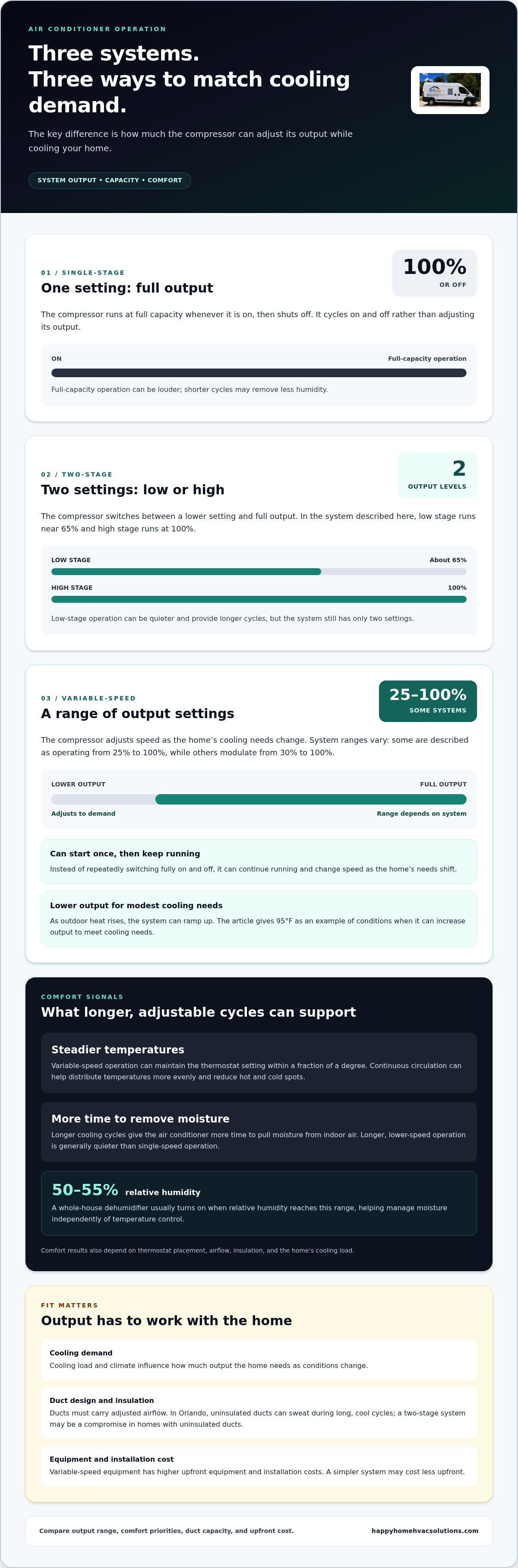
Single-stage compressors run at 100% capacity whenever they’re on, then shut off. Two-stage compressors switch between low and high output, with the system described here running near 65% on low and 100% on high. Variable-speed compressors adjust output across a range, allowing the equipment to respond more closely to changing cooling demand.
Yes. Variable-speed air conditioners are generally quieter than single-speed units because they can run at lower speeds, and longer cycles can remove more humidity. Two-stage systems can also be quieter when running at low speed instead of repeatedly starting at full capacity, but they offer only two settings.
Variable-speed models can operate across different capacity ranges. Some are described as modulating from 30% to 100%, while variable-speed HVAC systems can operate from 25% to 100%. The exact range depends on the system. Unlike a single-stage compressor that cycles on and off, a variable-speed compressor can start once and then run continuously, adjusting its speed as the home’s needs shift.
Home size alone doesn’t determine the best fit. The cooling load, climate, insulation, and duct design all matter: variable-speed equipment can match changing demand, while properly sized ducts must carry its adjusted airflow. In Orlando, ductwork is part of the system decision; uninsulated ducts can sweat during long, cool cycles. A two-stage system can be a compromise for homes with uninsulated ducts, providing longer low-speed cycles while reducing the risk of duct sweating.
Duct capacity also affects how staged equipment delivers air. A bypass damper can send excess supply air back toward the return when the duct system cannot use all the airflow. This can affect system operation, so matching equipment output to duct capacity matters. A variable-speed blower can adjust airflow, but it does not replace suitable duct sizing.
Noise partly depends on how hard the equipment runs. Single-stage systems deliver full output at startup, while two-stage equipment can spend more time at low output. Variable-speed equipment can run at lower capacity for longer, which generally makes it quieter than single-speed equipment. A home needing modest cooling, for example, may not require the same airflow as one facing greater demand.
| System | Compressor operation | Output or capacity | Noise and humidity |
|---|---|---|---|
| Single-stage | Cycles on and off | 100% or off | Full-capacity operation can be louder; shorter cycles may remove less humidity. |
| Two-stage | Switches between low and high | About 65% low, 100% high | Low-stage cycles can be quieter and longer. |
| Variable-speed | Adjusts speed to match demand | System ranges vary; some operate from 25% to 100%. | Lower-speed operation is generally quieter and supports longer humidity-removing cycles. |
Choose by comparing your home’s cooling load, duct capacity, and comfort priorities, rather than equipment type alone.
How does a variable-speed system work?
A variable-speed system responds to the thermostat by adjusting compressor and blower output to meet the home’s current cooling demand. Instead of delivering the same full output each time, it can run at lower capacity when rooms need only modest cooling. As outdoor heat rises, the system can increase output; at 95 degrees Fahrenheit, for example, it can ramp up to meet the home’s cooling needs. This gradual response helps limit abrupt temperature swings.
That adjustment supports steadier indoor comfort. A variable-speed system can maintain the thermostat setting within a fraction of a degree, while longer operating cycles keep conditioned air moving through rooms. Continuous circulation and filtration can help reduce hot and cold spots by distributing temperatures more evenly. Results also depend on thermostat placement, airflow, insulation, and the home’s cooling load.
Humidity removal is another part of the comfort equation. Longer cooling cycles give the system more time to pull moisture from indoor air instead of cooling quickly and shutting off. More consistent moisture removal can make a room feel less clammy, even when the thermostat setting stays the same. In Orlando’s humid climate, this may be especially relevant during mild weather, when a home needs less cooling than during a heat surge.
If the air conditioner hasn’t reduced indoor humidity enough, a whole-house dehumidifier can monitor moisture and operate between cooling cycles. It usually turns on when relative humidity reaches 50 to 55 percent. This helps address a different need from temperature control: the thermostat can be satisfied while indoor air still feels damp. Longer air-conditioning cycles can help with moisture, but a dehumidifier handles excess humidity independently.
Variable-speed operation can also affect energy use. Systems that adjust output to match heating or cooling demand use less electricity than equipment that relies only on an on-and-off cycle. The system does not simply run at one fixed low setting: it changes output as conditions shift, balancing airflow, cooling, and moisture removal. A programmable thermostat can further adjust temperature settings around occupancy patterns, helping the system respond to how the home is used.
- At home: Longer, lower-output operation supports more even room temperatures and ongoing air circulation.
- During a heat spike: The system can raise output to meet increased cooling demand.
- When humidity remains high: A whole-house dehumidifier can remove moisture between cooling cycles.
For comfort, consider temperature consistency and humidity together. A steady thermostat reading is only one measure; air circulation through bedrooms, living areas, and ductwork also shapes the indoor experience.
How multi-stage and variable-speed HVAC equipment works
Multi-stage HVAC equipment changes output as a home’s heating or cooling demand shifts. A single-stage air conditioner has one operating level: full capacity. A two-stage system adds a lower setting, allowing the thermostat to call for less output when the home needs only light cooling. Variable-speed equipment adjusts more gradually instead of switching between just two compressor stages.
In a two-stage air conditioner, the low stage can handle milder conditions while the high stage meets stronger demand. The system may start on low when indoor temperatures rise slightly above the thermostat setting, then switch to high if cooling demand increases. This staged approach allows longer, lower-speed operation without the finer adjustments of a variable-speed air conditioner.
Variable-speed equipment can adjust capacity to match changing conditions, helping avoid delivering more cooling than the home needs at a given moment. A programmable thermostat can also change temperature settings around occupancy patterns, but the equipment still needs appropriate capacity and airflow. Heating equipment can use staged operation too, adjusting output as a home’s heating demand changes.
A two-stage system can suit a homeowner who wants more than full-capacity operation but does not need variable-speed control. Its two settings offer a simpler step between single-stage and variable-speed equipment. The choice depends on the home’s load, duct design, and comfort priorities, not just the number of stages.
Single-stage systems generally have lower upfront equipment costs than more advanced options, while two-stage systems generally cost more than single-stage models. Compare the complete installation scope, required controls, and compatibility with existing ductwork, not just the equipment. Capacity matters too: a staged unit still needs to match the home’s heating and cooling requirements.
Variable-speed systems may qualify for local utility rebates. Eligibility for tax credits or other incentives depends on the specific program and equipment requirements.
Variable-speed equipment is more complex than single-speed equipment, so repairs can involve higher costs and manufacturer-specified parts. Annual tune-ups support system life, and a professional can diagnose faults such as control or airflow problems; AC repair addresses cooling-system issues.
Single-stage, two-stage, and variable-speed air conditioners can each last 15 years or longer with proper installation and annual maintenance. Warranty coverage is separate from lifespan: terms depend on the equipment and installation, so review the actual warranty documentation for its coverage period and conditions.
Upfront equipment and installation costs
For an Orlando homeowner comparing AC replacement options, equipment type is only one part of the upfront cost. Installation scope matters too: system capacity, compatible controls, existing ductwork, and any required changes can affect the project. A variable-speed system may also require a specialized smart thermostat, adding to the equipment requirements.
Variable-speed systems generally cost more upfront than single-stage or two-stage systems. Their advanced controls allow finer output adjustments, but that capability requires a higher initial investment. Two-stage models sit between these options, while single-stage units have simpler operation and generally lower equipment costs. The pros and cons of variable-speed HVAC systems come down to balancing that initial investment against features that may better match changing cooling demand.
Efficiency ratings help frame potential long-term savings, though they don’t predict a household’s exact energy bill. Single-stage air conditioners typically have SEER2 ratings from 13 to 15.1; two-stage models frequently range from 15.2 to 17. Variable-speed models can rate over 17 and up to 26 SEER2. Actual energy use also depends on the home’s cooling demand, system sizing, and operating habits.
When planning a replacement, compare the equipment’s upfront cost with its efficiency rating and likely operating pattern. Variable-speed equipment can adjust output instead of repeatedly running at full capacity, which may reduce electricity use. The pros and cons of variable-speed HVAC systems are especially relevant when weighing potential energy savings against higher initial equipment and installation costs.
There are drawbacks to consider. Variable-speed equipment is more complex than single-speed equipment, which can mean higher repair and maintenance costs. Repairs require manufacturer-specified parts, and the system needs a compatible smart thermostat. A homeowner prioritizing lower initial equipment costs may prefer a single-stage or two-stage option.
- Equipment: Compare system type, efficiency rating, and control requirements.
- Installation: Account for ductwork condition, capacity, and required modifications.
- Ownership: Weigh potential energy savings against equipment complexity and repair needs.
Installation costs depend on the project. Factors include system type, capacity, controls, ductwork, and installation scope, so compare the complete project rather than the equipment alone.
How variable-speed systems adjust output
A variable-speed air conditioner changes compressor output to match the home’s cooling demand. The thermostat signals when indoor conditions move away from the selected setting, and the system adjusts rather than relying only on full-capacity starts and stops. Some equipment modulates compressor output in 1% increments, allowing many small adjustments as demand changes.
Capacity ranges vary by system. Variable-speed HVAC equipment can operate from 25% to 100% capacity, while some variable-speed AC systems are described as modulating from 30% to 100%. At a mild demand, the compressor can run at a lower output; during hotter conditions, it can increase capacity to meet the cooling load.
The blower motor also shapes how this adjustment feels indoors. It changes airflow to match the building’s needs instead of moving the same volume of air at every operating level. A variable-speed blower paired with a single-stage compressor can adjust airflow, but both a variable-speed compressor and blower are needed for the full benefits of variable-speed technology.
This difference matters for energy efficiency. System startup and full-capacity operation are when an air conditioner uses the most energy. By adjusting output to match demand, variable-speed equipment can avoid running at full capacity when a home needs less cooling. Actual energy use still depends on the home’s cooling load, system sizing, airflow, and thermostat settings.
Humidity control is tied to runtime and output. A system running at lower capacity for longer can keep air moving and allow more time for moisture removal. If outdoor conditions shift, the compressor can respond to the changed demand instead of maintaining one constant output. The result is an operating pattern that balances temperature control, airflow, and humidity needs.
During a mild afternoon, for example, a home may need only modest cooling. The system can run below maximum output, then increase capacity as outdoor heat raises the indoor load. That is the core difference from an on-and-off system, which delivers its fixed output whenever it runs.
Output depends on more than the compressor. Duct design affects how much airflow the home can carry, while insulation and room layout influence how quickly heat enters. A system can adjust its capacity, but suitable sizing and airflow remain essential. These factors help determine whether the equipment can use its adjustment range effectively.
- Thermostat: Detects the need for heating or cooling and signals the system.
- Compressor: Changes cooling output to meet that demand.
- Blower: Adjusts airflow to suit the system’s operating level.
For a system matched to your home’s airflow and cooling needs, explore AC installation options.
Happy Home HVAC Solutions: AC Repair
Happy Home HVAC Solutions provides AC repair when cooling performance changes, airflow weakens, or unusual system behavior disrupts comfort. Accurate diagnosis matters for a variable-speed system because its compressor and controls adjust output instead of relying on one fixed operating level.
If an older unit needs replacing, AC installation can match system capacity and operation to your home. Insulation services may also address heat gain that affects cooling demand, while heating and furnace services support comfort beyond the cooling season.
Describe what you’re noticing, such as uneven temperatures, persistent humidity, or a system that struggles to maintain its settings. Contact Happy Home HVAC Solutions to discuss AC repair or installation for your home.
Choose the Next Step for Your Home
As you weigh the pros and cons of variable-speed HVAC systems, focus on the comfort issues you want to solve and how your home is used day to day. Note where temperatures feel uneven, when indoor air feels humid, and whether your current system struggles during peak cooling. These details can help shape a practical conversation about equipment and installation needs.
Happy Home HVAC Solutions can repair an existing system that isn’t performing as expected or install a replacement. The team also provides Heating & Furnace Services to support comfort beyond the cooling season. A clear description of your concerns gives the conversation a useful starting point.
Take the next step at a pace that feels right for your household. Contact Happy Home HVAC Solutions to discuss your home’s HVAC needs and move toward a more comfortable space.
Frequently Asked Questions
Are variable speed AC units more efficient?
Yes, variable-speed AC units can use energy more efficiently by adjusting output to match cooling demand. Compare the unit’s SEER2 rating, then make sure its capacity suits the home’s cooling load. Equipment that’s poorly matched to a home may not operate as intended, even with advanced controls. For a useful comparison, consider both the efficiency rating and the system’s fit with your home, not the technology label alone.
How does it work?
A thermostat senses indoor temperature and signals the system when cooling is needed. The controller then adjusts the compressor and blower to deliver the required cooling and airflow. If indoor temperature approaches the set point, for example, the system can reduce output rather than continuing at full capacity. This coordinated response helps the equipment follow changing demand instead of relying only on repeated full-output cycles.
What are the benefits of a variable-speed AC unit or heat pump?
A variable-speed AC unit or heat pump can provide cooling that better follows a home’s changing needs. A heat pump can also adjust its output for heating, making the same type of modulation useful across seasons. In an Orlando-area home, this may suit households that prioritize quieter operation and even comfort. The most useful benefits depend on the home’s heating and cooling needs, airflow, and equipment match.
How do variable-speed HVAC systems work?
Variable-speed HVAC systems adjust equipment output in response to demand. A programmable thermostat adds another layer of control by changing temperature settings around occupancy patterns. For example, a household can set different temperatures for occupied and unoccupied periods while the equipment adjusts output as needed. Thermostat schedules guide when comfort settings change; they do not replace system capacity or the need for suitable airflow.
What are the main benefits of variable-speed HVAC systems?
The main benefits include quieter operation, steadier indoor temperatures, and support for humidity removal through longer operating cycles. These qualities may matter if a room feels less comfortable than the rest of the house. Before choosing a system, identify the main concern: noise, uneven comfort, or damp-feeling air. That priority helps clarify whether variable-speed operation addresses a real household need.
How much do variable-speed HVAC systems cost to buy and install in the US?
The installed price depends on the equipment’s capacity, required controls, ductwork condition, and installation scope. A replacement that uses existing compatible ducts involves different work from one requiring duct changes or other adjustments. The price for an installation depends on the project and is provided after a quote request. Compare the complete installation scope and equipment requirements, rather than evaluating the unit alone.
How much energy can variable-speed HVAC systems save compared with single-stage systems?
A variable-speed air conditioner can use up to 75% less energy than a single-stage system. That figure describes the maximum stated potential, not a savings amount to assume for every home. To assess household energy use, compare bills across similar cooling periods and consider weather, thermostat settings, and how often the system runs. Those details help show whether energy use changes after an equipment upgrade.
How do variable-speed HVAC systems compare with two-stage and single-stage systems?
Single-stage equipment has one operating output, two-stage equipment offers low and high settings, and variable-speed equipment can adjust across a broader range. A homeowner prioritizing straightforward operation may prefer fewer operating levels; someone focused on finer adjustments may value variable speed. Compare those preferences with the home’s comfort needs, ductwork, and installation requirements. A useful comparison weighs everyday fit alongside the system’s available output settings.