
R-410A Refrigerant Phaseout and What It Means for Home AC
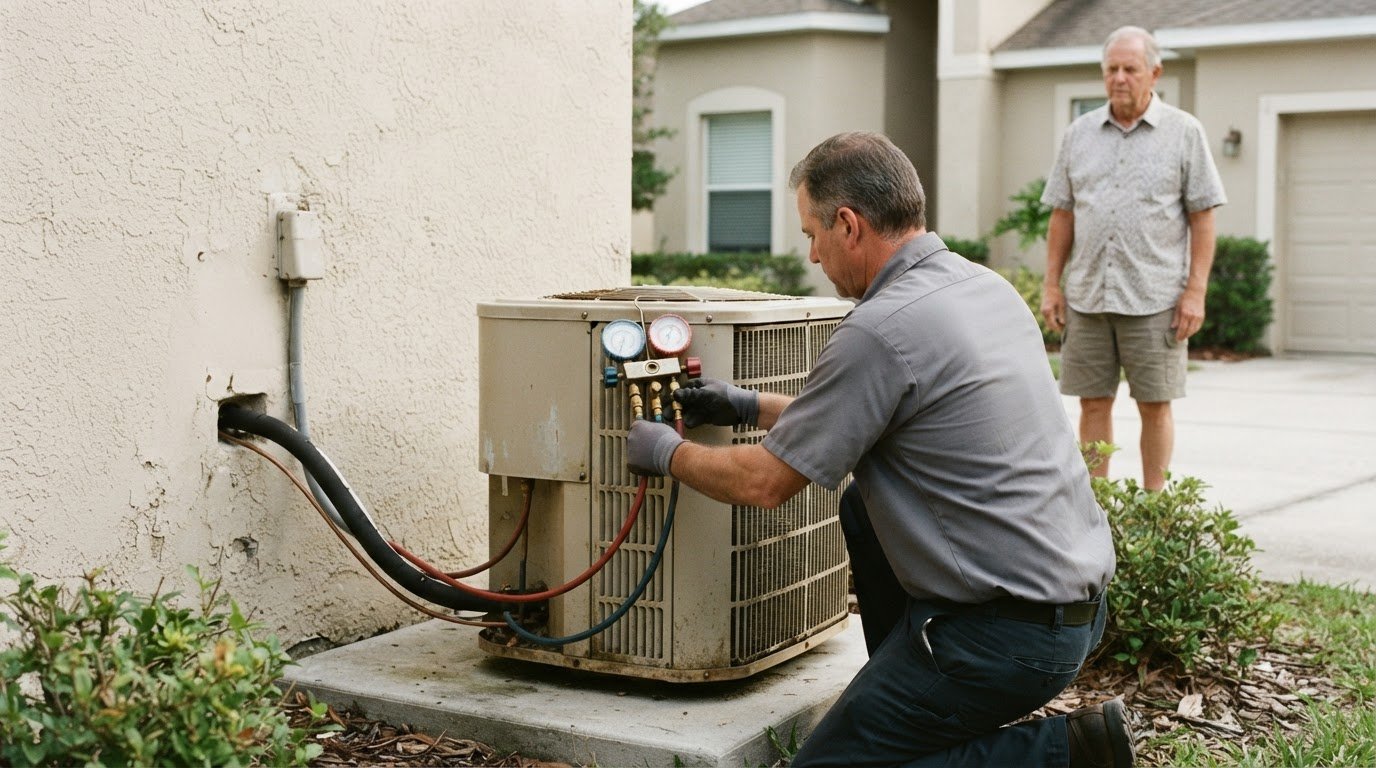
R-410A’s phaseout changes the rules for new air-conditioning equipment, not whether an existing system can keep running. If you’re wondering what R-410A refrigerant is, it’s a blend used in home AC and heat-pump systems; existing R-410A systems can continue to be used after 2025.
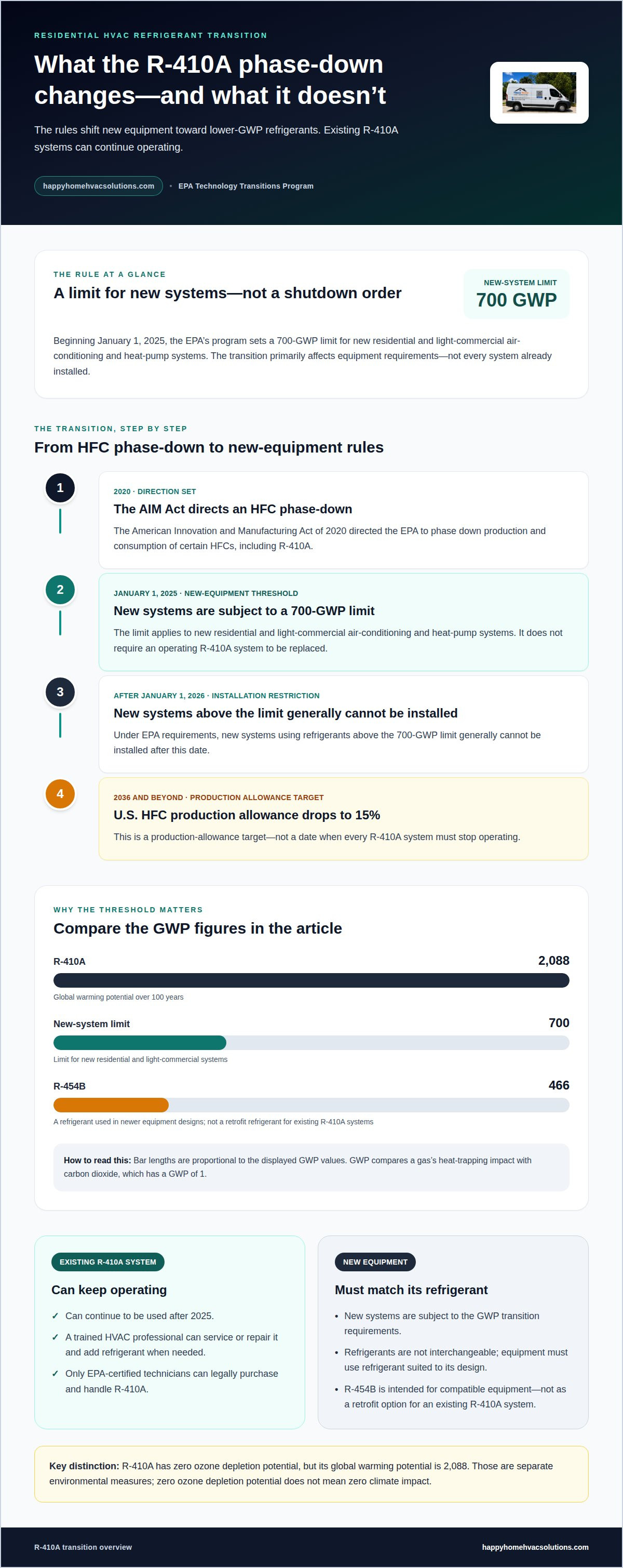
The transition can sound like a signal to replace your system right away, but that isn’t what the rule says. The U.S. Environmental Protection Agency’s Technology Transitions Program sets a 700-GWP limit for new residential and light-commercial air-conditioning and heat-pump systems beginning January 1, 2025. Under the EPA’s requirements, new systems using refrigerants above that limit generally cannot be installed after January 1, 2026.
This guide explains what R-410A is, why the U.S. is phasing down certain refrigerants, and how the transition affects homeowners with existing equipment. You’ll also see how R-410A compares with R-22, including why the two refrigerants aren’t interchangeable and what their different phaseouts mean when you’re weighing repair or replacement.
Key Takeaways
- The American Innovation and Manufacturing Act of 2020 directed the U.S. Environmental Protection Agency to phase down production and consumption of certain HFCs, including R-410A.
- R-410A is a 50/50 blend of R-32 and R-125, and its heat-transfer performance helps explain why it became a replacement for R-22.
- R-410A and R-22 differ in both environmental impact and system operation, so their refrigerants aren’t interchangeable.
- R-454B is a refrigerant for compatible new equipment, not a retrofit option for an existing R-410A system.
Is R-410A being phased out?
Yes. The United States is phasing down R-410A production and consumption, but existing home systems aren’t being switched off by the phase-down. The U.S. American Innovation and Manufacturing Act of 2020 directed the U.S. Environmental Protection Agency to phase down production and consumption of certain HFCs, including R-410A.
The distinction is between refrigerant supply and equipment already installed. A homeowner with an operating R-410A air conditioner can continue using it after 2025. A trained HVAC professional can service or repair an existing system and add refrigerant when needed. The regulatory transition primarily changes the requirements for new equipment, rather than requiring homeowners to replace every existing unit.
For new systems, the U.S. Environmental Protection Agency’s Technology Transitions Program sets a 700-GWP limit for new residential and light commercial air conditioning and heat pump systems. That threshold affects which refrigerants can be used in new equipment. It doesn’t make R-410A and alternatives interchangeable in older systems; equipment must use refrigerants suited to its design.
R-410A’s global warming potential is 2,088 over 100 years. Global warming potential, or GWP, compares a gas’s heat-trapping impact with carbon dioxide, which has a GWP of 1. R-410A has zero ozone depletion potential, so it doesn’t deplete the ozone layer. These are separate environmental measures: zero ozone depletion potential doesn’t mean zero climate impact.
That difference helps explain why the phase-down targets HFCs. The U.S. Environmental Protection Agency schedules the U.S. HFC production allowance to drop to 15% by 2036 and beyond. This is a production allowance target, not a date when every R-410A system must stop operating. As supply allowances fall, the regulatory focus remains on reducing HFC production and shifting new equipment toward lower-GWP refrigerants.
Can homeowners still buy R-410A equipment or refrigerant in the U.S.? Existing systems can remain in use, and qualified professionals can service them with refrigerant when needed. New equipment is subject to transition requirements, while only EPA-certified technicians can legally purchase and handle R-410A.
R-410A is classified as A1, non-flammable, under ISO 817 and ASHRAE 34. However, it operates at substantially higher pressure than R-22 systems, so handling it requires suitable training and equipment. Homeowners should leave refrigerant service, leak repair, and charging to an EPA-certified technician rather than opening or attempting to charge a sealed system.
What is R-410A refrigerant?
Understanding what R-410A refrigerant is starts with its chemistry: it’s a hydrofluorocarbon, or HFC, blend. The blend contains 50% R-32 and 50% R-125. Those two components circulate through compatible air-conditioning and heat-pump equipment, carrying heat away from indoor air and releasing it outdoors. R-410A is a refrigerant mixture, not a single chemical compound.
In cooling mode, the refrigerant absorbs heat as it evaporates inside the indoor coil. The compressor then moves and pressurizes the refrigerant, and the outdoor coil releases that heat as the refrigerant condenses. This cycle lets an air conditioner move heat rather than create cold. R-410A’s heat-transfer performance is significantly higher than R-22’s, supporting efficient heat exchange in equipment designed for it.
That performance depends on the entire system, not the refrigerant alone. Coils, compressor, metering components, and operating pressures must work together. A unit manufactured for R-410A is engineered around its refrigerant properties; substituting another blend can disrupt how the system operates. The same principle applies to a heat pump, which uses its refrigerant circuit to move heat in both heating and cooling modes.
R-454B is another HFC-containing blend used in newer equipment designs. Its composition is 68.9% R-32 and 31.1% R-1234yf, and its global warming potential is 466. R-410A’s components and R-454B’s components are different, so the blends aren’t interchangeable. R-454B is intended for equipment designed to use it, not as a retrofit refrigerant for an existing R-410A system.
As residential and commercial equipment transitions to lower-GWP refrigerants, homeowners may encounter different refrigerant names on new systems. The name alone doesn’t determine performance: equipment design, installation, and proper operation matter. For example, a heat pump made for R-454B must use components suited to that refrigerant. R-410A systems, likewise, need refrigerant and service compatible with their original design.
How much does R-410A refrigerant cost per pound and to recharge an AC? The cost depends on the case and is given after a quote request; the amount needed, diagnosis, and any leak repair affect the total. A recharge addresses refrigerant quantity, but a leak can cause the system to lose charge again if its source isn’t repaired.
R-410A doesn’t wear out during normal operation in a properly sealed system. If cooling weakens, the cause may involve a leak or another equipment issue, so adding refrigerant isn’t automatically the right fix. A technician can assess the refrigerant circuit and system condition before deciding whether service is needed. Knowing the blend in your equipment helps keep that evaluation aligned with its design.
Residential HVAC refrigerant transition rules
The U.S. transition changes requirements for new residential and light-commercial equipment, not the operation of every existing air conditioner. The U.S. Environmental Protection Agency’s Technology Transitions Program sets a 700-GWP limit for new residential and light commercial air-conditioning and heat-pump systems beginning January 1, 2025. GWP means global warming potential, a measure used to compare refrigerants’ climate impact.
The installation deadline follows that limit. Under the U.S. Environmental Protection Agency’s stated requirements, new residential and light-commercial systems using refrigerants above the 700-GWP limit generally cannot be installed after January 1, 2026. The word “generally” matters: the rule covers specified equipment and has exceptions. It doesn’t mean every system containing R-410A must be removed on that date.
For homeowners, the practical distinction is existing equipment versus a complete new system. Existing R-410A air conditioners and heat pumps can continue to operate after 2025. A trained HVAC professional can service or repair an existing system and add refrigerant if needed. Replacing a failed component is different from installing a complete new system, and existing R-410A components may still be replaced.
Equipment manufactured before January 1, 2025, may still be available for installation after 2025. That means the date on a system’s manufacture and the date it is installed can matter. The transition rules don’t make R-410A equipment or refrigerant instantly unusable; they guide which new residential and light-commercial systems can be installed under the applicable requirements.
Replacement timing also depends on the condition of the HVAC system. Many systems have a lifespan of 10-15 years, so an older unit nearing the end of its useful life may prompt a homeowner to weigh repair against full replacement. A repair may address a specific failure while preserving an otherwise serviceable system. A replacement involves choosing a complete system designed for an eligible refrigerant.
Commercial equipment doesn’t automatically follow the same requirements as residential equipment. The 700-GWP limit described here applies to new residential and light-commercial air conditioning and heat pumps. The equipment category and system design determine which transition requirements apply, so “commercial” alone doesn’t describe every covered system.
Does handling or purchasing R-410A require EPA Section 608 certification? Only EPA-certified technicians can legally purchase and handle R-410A. Homeowners should leave refrigerant work to certified professionals, while they can make informed decisions about whether their existing system needs repair or replacement.
R-410A’s thermal performance compared with R-22
R-410A and R-22 both transfer heat in air conditioners, but they have different operating characteristics. R-410A systems operate at approximately 40 to 70% higher pressure than R-22 systems. That difference matters because compressors, coils, and other components must be designed for the refrigerant and its pressure range. R-410A also allows significantly higher heat-transfer rates than R-22, supporting its use in compatible equipment.
R-22 contains chlorine, which contributes to ozone depletion; R-410A contains no chlorine and has zero ozone depletion potential. Their climate impacts are different from their ozone effects: R-22 has a global warming potential of 1,810, while R-410A’s is 2,088 over 100 years. Neither measure describes system efficiency by itself. Efficiency also depends on equipment design, installation, and operating condition.
“Freon” is a brand name for R-22, not a general name for every refrigerant. R-410A is not Freon. This distinction helps homeowners interpret older equipment labels and service discussions accurately. R-410A became a replacement for R-22 in residential and commercial air conditioning, but the refrigerants have distinct properties. A unit designed for one cannot be assumed to perform correctly with the other.
How does R-410A compare with R-22 and R-32 refrigerants? R-410A is a 50/50 blend of R-32 and R-125, while R-32 is a single-component HFC with a 100-year global warming potential of 675. R-410A’s GWP is 2,088, and R-22’s is 1,810. R-410A also operates at substantially higher pressure than R-22, so these refrigerants aren’t interchangeable.
R-454B offers another comparison for homeowners considering newer equipment. Its GWP is 466, and it’s composed of 68.9% R-32 and 31.1% R-1234yf. Its lower climate impact doesn’t make it suitable for every existing system. R-454B is not intended as a retrofit refrigerant for an R-410A system; equipment must be designed for the refrigerant it uses.
Can you mix R-410A with other refrigerants or retrofit an R-22 system? Don’t treat another refrigerant as a top-off or drop-in replacement: R-410A and R-22 have different operating pressures, and R-454B isn’t a retrofit refrigerant for R-410A equipment. A system’s design determines which refrigerant it can use.
The American Innovation and Manufacturing Act of 2020 directed the U.S. Environmental Protection Agency to phase down production and consumption of certain HFCs, including R-410A. That transition concerns refrigerant production and new equipment requirements; it doesn’t change the physical differences among R-410A, R-22, and R-32. For an existing system, the key comparison is its designed refrigerant, operating condition, and repair needs.
What R-410A refrigerant is
R-410A is a hydrofluorocarbon refrigerant blend used in air conditioning and heat-pump equipment designed for it. Its chemical composition is 50% R-32 and 50% R-125. R-32 is difluoromethane; R-125 is pentafluoroethane. Those component names describe the blend’s ingredients, while R-410A identifies the refrigerant used by compatible equipment. It is not a single chemical compound.
Inside an air conditioner, R-410A circulates through a sealed refrigerant circuit. It absorbs heat indoors as it changes from liquid to vapor, then releases heat outdoors as it condenses. A compressor moves the refrigerant through that cycle. The same basic heat-transfer process operates in a heat pump, which can move heat in either direction depending on its mode.
The exact blend matters because system components are selected around R-410A’s properties. Compressors, coils, and metering devices work as a coordinated system; refrigerant is not a generic fluid that can be swapped freely. For example, adding another refrigerant to an R-410A charge changes what circulates through components designed for the original blend. That can interfere with intended system operation.
R-410A became a common replacement for R-22 in equipment manufactured after 2009. R-22 contains chlorine, while R-410A does not, so R-410A has zero ozone depletion potential. The distinction illustrates why refrigerants are compared using separate environmental measures. Ozone depletion potential describes effects on the ozone layer; global warming potential compares heat-trapping impact.
The climate measure still matters. R-410A’s global warming potential is 2,088 over 100 years, despite its zero ozone depletion potential. The American Innovation and Manufacturing Act of 2020 directed the U.S. Environmental Protection Agency to phase down the production and consumption of hydrofluorocarbons. That phased transition concerns HFC production and new equipment rules, not the chemical identity of refrigerant already in a sealed system.
For a homeowner, the practical takeaway is to match the refrigerant to the equipment label and design. An R-410A system needs service compatible with R-410A; a newer system designed for another refrigerant has different requirements. Experts at Happy Home HVAC Solutions emphasize that a refrigerant name on a label can therefore help identify the correct service approach. If an older unit needs attention, the cause of poor cooling matters as much as the refrigerant type.
Happy Home HVAC Solutions
Happy Home HVAC Solutions can help you understand what your R-410A system needs as refrigerant rules change. If cooling has weakened or the system needs service, AC Repair can assess its condition and identify whether the issue involves refrigerant or another component. If replacement becomes the practical option, AC Installation can help you consider equipment designed for current requirements.
The right choice depends on your system’s condition, what caused the problem, and whether a repair can restore reliable operation. The refrigerant name alone does not determine whether to repair or replace your AC. For guidance in Orlando, Oviedo, Winter Springs, Winter Park, or Altamonte Springs, contact Happy Home HVAC Solutions.
Make a Confident Plan for Your Home
Understanding what R-410A refrigerant is gives you a clearer starting point, but your next move should reflect your home’s comfort needs and equipment condition. Rather than replacing a working system solely because refrigerant rules are changing, consider what you need from your AC, how it’s performing, and whether a repair or a new installation makes sense for your situation.
Happy Home HVAC Solutions provides AC Repair, AC Installation, and Heating & Furnace Services. Discussing your equipment with the team can help clarify the practical considerations for your home and the next step.
When you’re ready to discuss your home comfort needs, contact Happy Home HVAC Solutions. Take the next step at a pace that feels right for your home.
Frequently Asked Questions
Is R-410A Freon®?
No. Freon is a brand name for R-22, while R-410A is a different refrigerant blend. The distinction matters when identifying equipment or discussing service: an older system label may identify R-22, while a newer system may specify R-410A. The names aren’t interchangeable, and neither refrigerant should be added to equipment designed for the other. A technician can use the system’s labeling to identify its specified refrigerant.
What happens if my current system uses R-410A?
Your system can continue operating; the phase-down doesn’t require you to replace working R-410A equipment. If cooling changes or the unit needs repair, the technician can assess its condition and service it using refrigerant compatible with its design. For example, reduced cooling doesn’t by itself show that the system needs replacement. The cause may involve refrigerant loss or another component, so diagnosing the actual issue helps guide the next decision.
What if my AC unit or heat pump uses an older refrigerant?
An older refrigerant label doesn’t mean the equipment must be removed immediately. R-22 systems can still be evaluated for repair, while the refrigerant’s production and import restrictions affect supply. Since January 1, 2020, the United States has banned R-22 production and importation. A trained HVAC professional can assess the system’s condition and refrigerant requirements; don’t mix refrigerants or treat another blend as a drop-in substitute.
Why is R-410A banned?
R-410A isn’t subject to a blanket ban on using existing systems. Its phase-down addresses HFC production and consumption because R-410A has a global warming potential of 2,088 over 100 years. It has zero ozone depletion potential, so its climate impact and its effect on the ozone layer are separate issues. The U.S. American Innovation and Manufacturing Act of 2020 directed the U.S. Environmental Protection Agency to phase down certain HFCs, including R-410A.
What types of air conditioners and heat pumps use R-410A?
Residential and commercial air conditioners and heat pumps may use R-410A when their equipment is designed for that refrigerant. R-410A replaced R-22 in systems manufactured after 2009, but that doesn’t mean every unit from that period uses the same refrigerant. For a practical example, identify the refrigerant on the unit’s equipment label before arranging service. The label helps distinguish R-410A equipment from systems designed for another blend.
What are the properties and operating pressures of R-410A?
R-410A is classified as A1, non-flammable, under ISO 817 and ASHRAE 34. Its pressure is higher than R-22’s: R-410A systems operate at approximately 40 to 70% higher pressure than R-22 systems. That difference affects the components and service procedures suited to each system. Refrigerant handling should be left to an EPA-certified technician, rather than attempted with tools or procedures intended for a different refrigerant.
Is R-410A being phased out in the United States, and when?
Yes, the U.S. is transitioning new residential and light-commercial equipment to refrigerants with lower global warming potential. The U.S. Environmental Protection Agency sets a 700-GWP limit for new residential and light-commercial air-conditioning and heat-pump systems. Under its stated requirements, systems using refrigerants above that limit generally cannot be installed after January 1, 2026. Existing R-410A systems can continue to operate; the transition doesn’t set a removal date for them.
How much does R-410A refrigerant cost per pound and to recharge an AC?
The total recharge cost depends on the amount needed, the diagnosis, and whether a leak needs repair.