
How to troubleshoot furnace pilot light issues and check repair costs
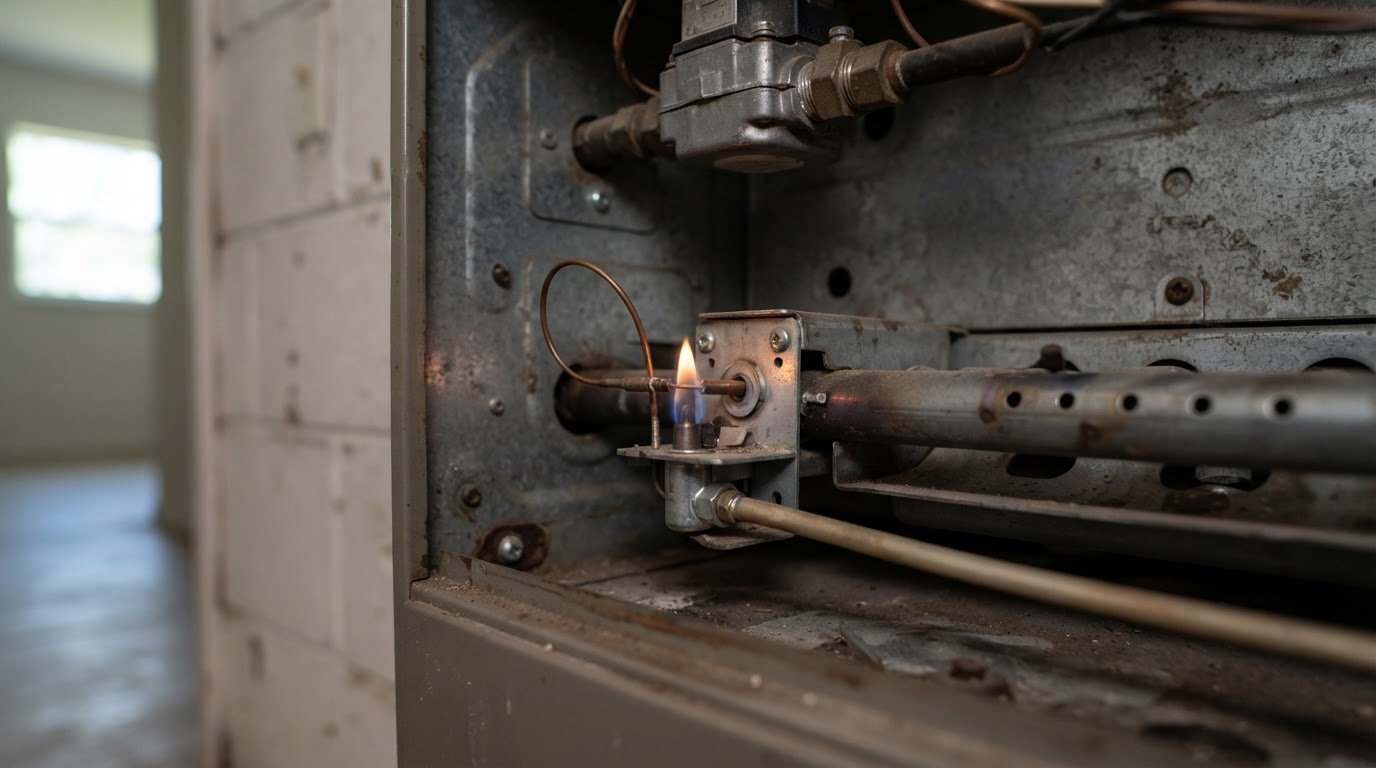
A pilot light that won’t stay lit is a symptom, not a diagnosis. Troubleshooting furnace pilot light issues starts with understanding that this small flame ignites the furnace burners. Repeated outages can point to a dirty pilot opening, a draft, a faulty thermocouple, or another issue that needs attention. A steady blue flame with a small yellow tip is normal; a mostly yellow or orange flame needs professional attention.
It’s understandable to want the heat back quickly, but repeated relighting can leave the underlying cause unresolved. If you smell gas, don’t try to relight the furnace. Leave the home immediately and contact your gas provider from outside.
This guide explains how pilot lights work, what can keep one from staying lit, and when relighting isn’t safe. You’ll also learn what can affect repair costs, so you can understand what a professional may need to inspect and repair before restoring reliable heat.
Key Takeaways
- A thermocouple detects heat from the pilot flame and helps control gas flow, so a fault can affect whether the pilot stays lit.
- Relight only by following the furnace manufacturer’s instructions, and stop if the pilot won’t remain lit after a few attempts.
- Standing-pilot furnaces and electronic-ignition models work differently, so identifying the ignition type helps narrow down the issue.
- The repair needed depends on the underlying fault; diagnosis and the parts and labor involved shape the estimate.
- Repeated pilot problems or unusual operation call for professional furnace service rather than continued troubleshooting.
What Is a Furnace Pilot Light?
A pilot light is a small flame that ignites gas at the furnace burner. A blinking status light is a separate diagnostic signal, and its meaning depends on the furnace model and blink pattern.
-
Identify a Lit Pilot Flame
Observe the pilot through the furnace’s viewing opening, if your model has one. On many furnaces, the flame is near the lower front, behind an access panel. Don’t remove panels or reach inside to look. A lit pilot is a small, steady flame beside the burner assembly; the main burners may be off while it remains lit.
If the flame is difficult to see, don’t assume it has gone out. Check the furnace’s indicator window or model instructions for the intended viewing point. Never adjust the gas valve to improve visibility or test whether the flame will stay lit. If you can’t identify the pilot safely, leave the inspection to a technician.
-
Compare Healthy and Abnormal Flames
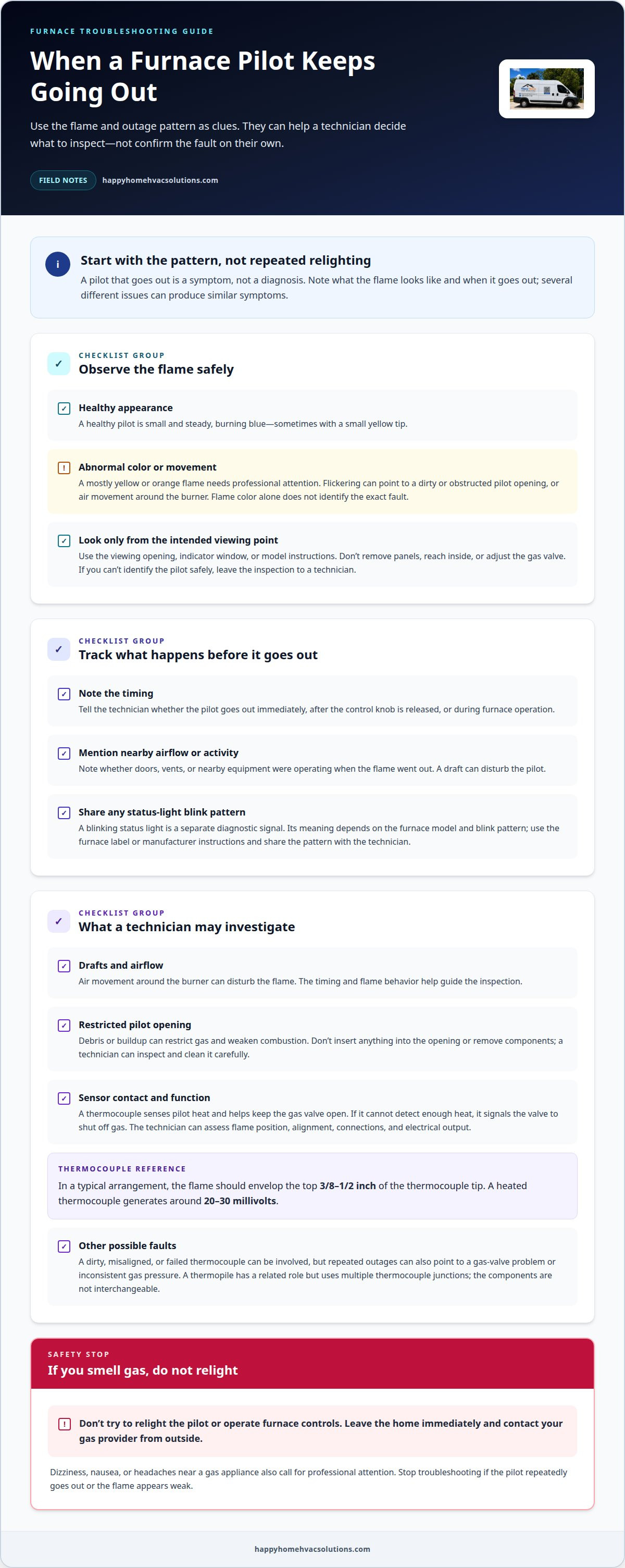
Compare the visible flame’s color and stability without touching the furnace. A healthy pilot burns steadily blue, sometimes with a small yellow tip. A mostly yellow or orange flame is abnormal and can signal incomplete combustion. A flickering flame may point to a dirty or obstructed pilot opening, or air movement around the burner.
Notice whether the flame reaches the nearby safety sensor. In a typical thermocouple arrangement, the flame envelops the sensor tip; if contact is poor, the system may not detect enough heat to keep gas flowing. A weak or misdirected flame needs professional diagnosis, not hand adjustment. Flame color alone doesn’t identify the exact fault.
- Treat gas odors as a stop signal. If you smell gas near the furnace, don’t try to relight the pilot or operate its controls. Leave the home immediately and contact your gas provider from outside. Dizziness, nausea, or headaches near a gas appliance also call for professional attention. The Centers for Disease Control and Prevention recommends battery-powered carbon monoxide detectors and checking their batteries when clocks change in spring and fall.
For a furnace in Orlando, the Orlando service area page provides local service information for arranging professional attention.
- Use the status light as a clue, not a diagnosis. A blinking furnace status light usually signals that the control board is reporting an operating condition or fault. The blink sequence and meaning vary by model, so use the furnace’s label or manufacturer instructions to interpret it. Share the pattern with a technician rather than opening controls or changing wiring.
A pilot that repeatedly goes out, appears weak, or fails to heat its safety sensor may involve a clogged pilot orifice, a sensor problem, or another fault. A technician can safely inspect the pilot assembly, sensor contact, and gas valve, then identify appropriate repairs. If the flame is mostly yellow or orange, arrange professional attention rather than treating the color as normal.
Drafts, clogged pilots, and faulty thermocouples
A pilot that repeatedly goes out can have several causes, including airflow, a restricted pilot opening, or a faulty thermocouple. A technician can use the timing and pattern to narrow down what to inspect. Careful troubleshooting distinguishes a disrupted flame from a sensor or gas-control fault.
-
How Professionals Check for Drafts and Clogged Pilots
Tell the technician when the flame goes out and whether doors, vents, or nearby equipment were operating. A draft can disturb the pilot flame, while debris or buildup in the pilot opening can restrict gas and weaken combustion. These faults can look similar from outside the furnace, so the timing and flame behavior help guide the inspection.
Ask the technician to inspect airflow around the burner and the pilot opening. Don’t insert anything into the opening, remove components, or adjust the gas valve. A restricted passage needs careful cleaning, while a draft may require a different correction. A technician can distinguish between these causes without risking damage to the pilot assembly.
-
Understand Thermocouple and Thermopile Functions
Ask which safety sensor your furnace uses and how it responds to the pilot flame. A thermocouple senses heat and helps keep the gas valve open while the pilot burns. If it cannot detect heat, it signals the valve to shut off gas. A heated thermocouple generates around 20-30 millivolts.
A thermopile serves a related purpose but uses multiple thermocouple junctions to generate a stronger electrical output for compatible controls. The two components aren’t interchangeable. Their roles depend on the furnace design, so a technician identifies the installed sensor before testing or selecting a replacement.
-
Recognize Thermocouple Failure Symptoms
Describe whether the pilot goes out immediately, after the control knob is released, or during furnace operation. A pilot that won’t stay lit after the knob is released can indicate a dirty, misaligned, or failed thermocouple. Repeated outages can also result from a blocked pilot opening, a draft, a gas-valve problem, or inconsistent gas pressure.
Ask the technician to assess the flame’s position against the sensor, not just whether the sensor looks intact. For proper positioning, the pilot flame should envelop the top 3/8-1/2 inch of the thermocouple tip. A weak flame or poor contact can prevent reliable heat detection, even when the sensor itself isn’t faulty.
-
How Professionals Troubleshoot Thermocouple Function and Replacement Costs
Request a diagnosis that tests the thermocouple and checks its alignment, connections, and pilot flame. A technician can measure its electrical output and determine whether the sensor is failing or another fault is interrupting the safety circuit. This helps avoid replacing a working thermocouple when the actual cause is a clogged opening, draft, or gas-control issue.
Ask for an estimate that separates diagnosis, parts, and labor. Replacement costs depend on the furnace design, access to the sensor, the part required, and whether additional repairs are needed. A thermocouple part alone differs from a completed professional repair, which includes labor and testing. Don’t remove or replace the sensor yourself; leave gas-valve and furnace repairs to a qualified technician. For troubleshooting furnace pilot light issues, share the model and symptoms so the technician can focus the assessment.
Safe limits on relighting a pilot
A professional first checks for hazards, identifies the furnace’s ignition system, and follows the manufacturer’s instructions. If you smell gas, don’t relight the pilot. Leave immediately and contact your gas provider from outside.
- Stop when warning signs appear. A gas odor means no relighting attempts and no operation of the furnace controls. Leave the home immediately, then contact the gas provider from outside. Dizziness, nausea, or headaches near a gas appliance also need professional attention. If the pilot has gone out repeatedly, tell the technician how often it happened and what the furnace was doing beforehand.
- Confirm the furnace’s instructions and condition. The technician identifies whether the appliance has a standing pilot light and locates its specific relighting procedure. Before proceeding, they check for warning signs and review the pilot’s behavior. If the gas control knob is turned to Off as part of the procedure, they wait at least 5 minutes before attempting ignition, allowing gas to dissipate.
- Follow the model-specific relighting sequence. A professional uses the furnace manufacturer’s instructions rather than applying one sequence to every model. Depending on the controls, the procedure may call for holding the gas control knob down for 20-30 seconds after ignition. A furnace with a pilot reset button may call for holding it for 30-60 seconds, allowing the flame to heat the thermocouple. These are distinct instructions, not steps to combine.
- Verify operation and stop at the attempt limit. After relighting, a technician checks whether the flame remains stable and the furnace responds as expected. If the pilot won’t stay lit after two or three relighting attempts, stop; continued attempts won’t resolve an underlying fault. A technician can investigate the sensor, pilot opening, draft, gas valve, or gas supply instead of repeatedly relighting.
- Arrange inspection for recurring outages. A pilot that goes out more than once or twice per heating season typically indicates a problem that should be inspected. Note when it happens, whether the furnace was starting, and whether the flame went out after the control knob was released. These details help a technician distinguish a relighting issue from a fault needing repair or replacement.
Differences between standing pilots and electronic ignition
Identify the ignition type before interpreting a furnace that won’t ignite. A standing pilot keeps a small flame burning, while electronic ignition creates a flame only when the furnace calls for heat.
- Use the furnace’s model information to identify its ignition system. Standing pilot lights are typically found in older furnaces, generally those made before 2010. Most furnaces manufactured after 2010 use electronic ignition, such as a hot surface igniter or intermittent pilot. These dates are useful clues, not a substitute for checking the model label or manufacturer instructions.
A standing pilot remains lit between heating cycles. An electronic system does not maintain a continuous flame. If you can’t tell which system your furnace uses, give its model information to a technician instead of removing panels or testing components.
- Note what happens when the thermostat calls for heat. With a standing pilot, the small flame is already present; the furnace uses it to ignite the main burner. With electronic ignition, the system begins an ignition sequence when heat is needed. A hot surface igniter heats to start combustion, while an intermittent pilot creates a flame for that cycle.
That difference changes what “no flame” may mean. A missing standing pilot is an interrupted continuous flame. No visible flame on an electronic model between heating calls can be normal. Record whether the furnace was actively trying to heat when you noticed the issue.
- Consider the energy tradeoff when assessing an older standing pilot. A standing pilot uses natural gas continuously, including when the main burner is off. It can account for up to 50% of a furnace’s total gas consumption. Older furnaces with standing pilots operate at about 50-70% efficiency, while modern electronic-ignition furnaces typically range from 94-98.5% AFUE.
These figures describe different operating characteristics, not a diagnosis of your furnace. A continuously lit pilot does not prove the furnace is operating correctly, and an electronic igniter doesn’t guarantee successful ignition. The furnace’s condition and fault symptoms still matter.
- Use repeated ignition failures to guide a professional diagnosis. If a standing pilot goes out, a technician can investigate the pilot flame, sensor, and gas controls. If an electronic ignition system fails to ignite during a heat call, the technician can assess its ignition components and controls. Don’t assume both systems use the same parts or repair steps.
About 5% of furnaces still use standing pilot lights. Identifying the system helps explain why a flame may be absent and prevents confusing a normal electronic-ignition pause with a failed standing pilot. Share the model and the circumstances of the failure with the technician.
Pilot-light repair costs
A useful repair estimate starts with diagnosis, not the visible flame alone. A yellow flame, repeated outages, and failed ignition can point to different work, so the underlying cause matters more than the symptom.
- Ask for the cause and proposed repair separately. A technician may find a restricted pilot opening, a faulty thermocouple, a draft, or a gas-valve problem. Each involves different inspection and repair work. Ask what testing located the fault and which repair addresses it. This makes it easier to understand whether the estimate covers diagnosis, parts, labor, or multiple repairs.
A pilot that goes out after the control knob is released, for example, may lead to a thermocouple check. A mostly yellow flame calls for attention to combustion and the pilot assembly. Symptoms help direct the inspection, but don’t establish the final repair by themselves.
- Understand what changes the repair estimate. The total depends on the failed component, the furnace model, access to the part, and the labor involved. A thermocouple replacement differs from work on a gas valve or a blocked pilot opening. If a technician finds multiple faults, the estimate may include separate repairs rather than one simple part replacement.
Parts pricing also differs from the cost of a completed repair. Installation, testing, and any additional work affect the final amount. Ask for an itemized estimate that identifies the part and labor and explains whether the quoted work restores safe, consistent ignition.
- Use the furnace manual and model details to clarify the scope. The model information helps identify the ignition system and compatible parts. Share the manual, if available, and describe when the pilot fails, how often it happens, and whether the furnace was heating. These details help the technician narrow the inspection and explain the proposed work.
A standing-pilot repair may involve different components than an electronic-ignition repair. Don’t assume a quote for one system applies to the other. The technician should locate the fault before recommending replacement or additional repairs.
- Request a written quote before authorizing repair. The price depends on the diagnosis, required parts, access, and labor. If the estimate includes replacement, ask which component is being replaced and why. This keeps the decision focused on the identified problem rather than a guess based on flame color alone.
For a pilot that repeatedly fails during heating, request furnace repair service and share the model and symptoms. That information gives the technician a clearer starting point for diagnosis and an estimate.
Happy Home HVAC Solutions: Heating & Furnace Services
Happy Home HVAC Solutions provides Heating & Furnace Services for homeowners dealing with a pilot that repeatedly goes out, a weak flame, or a furnace that won’t ignite. Professional service can identify whether the issue involves the pilot assembly, thermocouple, gas valve, or another furnace component, then explain the repair needed. Share the furnace model and symptoms you’ve noticed to help focus the assessment. If the furnace has a gas odor or unusual flame, stop troubleshooting and follow the safety steps described above. For a pilot problem that needs professional attention, contact Happy Home HVAC Solutions to discuss furnace service.
Take the Next Step Toward Reliable Home Comfort
A clear record of your furnace model and the conditions surrounding a failure can make troubleshooting furnace pilot light issues more focused. Note whether the problem occurs during a heating cycle, after the furnace has been idle, or following a previous repair. These details help a technician understand what you’ve observed and discuss an appropriate next step.
For furnace concerns, Happy Home HVAC Solutions provides Heating & Furnace Services. The company also offers AC Repair and AC Installation, supporting comfort needs beyond the current heating issue. Share the symptoms you’ve noticed and the model information you have, and ask about the next step for your home.
Contact Happy Home HVAC Solutions to discuss your furnace concern and move toward a more comfortable home.
Frequently Asked Questions
How Can a Professional Tell If a Furnace Thermocouple Is Bad?
A professional tests the thermocouple’s electrical output and checks its position beside the pilot flame. A heated thermocouple generates around 20-30 millivolts; a weak reading can help identify a sensor problem. The technician also checks whether the pilot flame properly heats the sensor and whether connections or other faults affect operation. These checks help distinguish a faulty thermocouple from a separate gas-control issue.
Troubleshooting: What If the Pilot Won’t Stay Lit?
If the pilot won’t stay lit, stop repeated relighting and note when it goes out. For example, record whether it fails after the control knob is released or later during furnace operation. Those different patterns help a technician narrow down the cause. A gas odor changes the response: don’t relight the furnace, leave the home immediately, and contact your gas provider from outside.
What Information Should You Provide Before Calling for Repair?
Provide the furnace model, the ignition type if known, and a clear description of what happens. Mention whether the pilot ignites briefly, goes out after the knob is released, or never appears during a heating call. Share any status-light blink pattern and when the trouble began. If you noticed an unusual odor or flame color, include that detail without restarting the furnace to observe it again.
What Should You Avoid Doing Before a Professional Arrives?
Don’t remove furnace components, probe the pilot opening, adjust the gas valve, or attempt to repair wiring. Avoid repeated relighting if earlier attempts failed; follow the furnace manufacturer’s instructions for any permitted relighting. If you smell gas, don’t operate controls or switches, and don’t try to ignite the pilot. Leave the home immediately and contact your gas provider from outside.
Why won't my furnace pilot light stay lit?
A pilot may go out because its flame is weak or disrupted, its opening is obstructed, or its thermocouple can’t sense enough heat. A draft, gas-valve problem, or inconsistent gas pressure can also contribute. Timing offers a useful clue: a flame that fails as the control knob is released may point to thermocouple condition or alignment. A technician can test the system and identify the cause.
How Can a Professional Tell If a Furnace Thermocouple or Flame Sensor Is Faulty?
A professional first identifies which sensor the furnace uses, since a standing-pilot thermocouple and an electronic-ignition flame sensor serve different systems. The technician then checks the component’s condition, positioning, connections, and response during an ignition cycle. A symptom alone doesn’t prove the sensor has failed. No ignition can also involve another control or fuel-delivery fault, so diagnosis tests the complete sequence.
Can a dirty pilot orifice or draft cause pilot light problems?
Yes. A restricted pilot orifice can reduce or disrupt the flame, while moving air can make it unstable or extinguish it. A technician can inspect the opening and airflow around the burner to distinguish these possible causes. Don’t insert a tool into the orifice or move furnace components to test for drafts. Describe when the flame changes, such as during a heating cycle or when nearby doors open.
What Will a Professional Check If the Furnace Pilot Won’t Ignite at All?
A technician identifies whether the furnace uses a standing pilot or electronic ignition, then follows that model’s diagnostic sequence. The inspection may include the gas supply and valve, pilot opening, ignition components, safety sensor, and control signals. The furnace’s status-light pattern and response to a heating call can help narrow the fault. If you smell gas, leave immediately and contact your gas provider instead of troubleshooting.