Furnace Repair in Central Florida: 2026 Homeowner's Guide
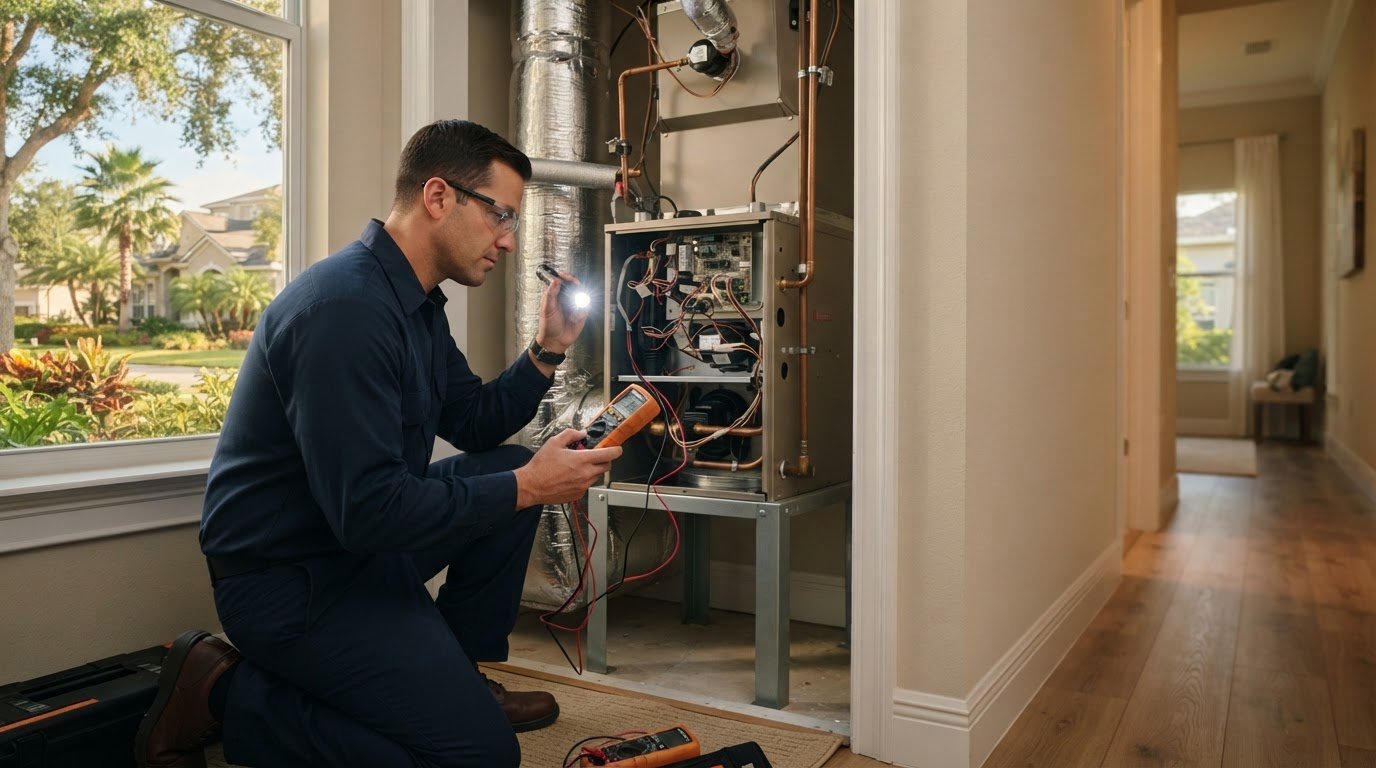
What if a furnace that won’t keep your home warm needs a careful repair, not a full replacement? During a Central Florida cold spell, uneven heat, a system that won’t start, or unusual noises can make home uncomfortable and leave you wondering what’s wrong. Reliable furnace repair Central Florida homeowners can count on starts with identifying the cause, not guessing from a symptom.
It’s reasonable to want clear answers before approving work, especially if you’re concerned about safety or being pushed toward a new system. In Florida, “furnace” may refer to electric heating equipment paired with a heat pump or air conditioner. The right diagnosis depends on the equipment in your home.
This guide covers common furnace problems, warning signs that call for professional attention, and what a sound diagnosis should involve. It also explains how to weigh repair against replacement without relying on a one-size-fits-all rule. Happy Home HVAC Solutions is a family-owned, licensed HVAC company serving Central Florida, with heating and furnace services to help address diagnosed problems.
Key Takeaways
- Notice when a heating concern becomes a recurring shutdown, unusual operation, or loss of heat that needs professional attention.
- A sound diagnosis starts by identifying your equipment, then inspecting and testing before recommending a repair.
- Compare repair and replacement based on your system’s condition, recurring problems, reliability, and future needs.
- Prepare for a service visit by noting symptoms and equipment behavior, without opening the system or attempting electrical or gas repairs.
- Furnace repair Central Florida homeowners can rely on begins with a licensed local HVAC company identifying the problem and explaining the next step.
Furnace Repair in Central Florida: Which Symptoms Need Attention?
Heating trouble can feel unsettling, even in Central Florida, where cold weather often arrives in short spells. A room that takes longer to warm up may be a temporary comfort issue, but repeated shutdowns, unusual operation, or no heat at all deserve closer attention. Intermittent problems are easy to dismiss if the system works again before a technician arrives. Note when the issue happens so the pattern is clear during the visit.
Symptoms are clues, not a diagnosis. No heat might relate to the thermostat, power, or a system fault; uneven warmth can have several explanations. Equipment varies too: a home may have a furnace or an air handler paired with a heat pump. For background on types of central heating furnaces, remember that a general overview can’t identify the equipment or issue in your home. A professional inspection can.
What furnace warning signs should homeowners notice?
Pay attention to what changed, not just whether the heat works at one moment. Note when the symptom began, how often it occurs, and whether it appears at a particular time or setting. Those details help describe the problem without guessing at a failed part.
- No heat: The system runs but the home stays cold, or it won’t start.
- Uneven heating: Some rooms feel comfortable while others remain noticeably cooler.
- Short cycling: The system starts and stops repeatedly instead of maintaining heat.
- Unusual sounds: Note whether you hear a new rattle, buzzing, scraping, or repeated clicking, and when it happens.
- Unexpected operation: Watch for changes in airflow, response to thermostat settings, or how frequently the system runs.
A sound can have several possible explanations, so don’t treat it as proof that a specific component has failed. If the same pattern returns, professional furnace repair Central Florida service can help identify the cause rather than rely on a guess. If the system also has cooling concerns, that history may add context. Happy Home HVAC Solutions provides air conditioning repair as well.
When should a furnace problem be treated as a safety concern?
Suspect a gas leak? Leave the area and seek emergency help from a safe location. Don’t operate the furnace or switches. If anyone experiences possible carbon monoxide symptoms, such as headache, dizziness, nausea, or confusion, move outside to fresh air and contact emergency services. Don’t run equipment that appears unsafe or displays an active safety warning. These steps address immediate safety and are separate from arranging routine heating service.
Persistent furnace symptoms merit professional diagnosis because the same warning sign can have several causes. Identifying the right one helps avoid guesswork. Describe what you noticed and when it occurs. Clear observations give a technician a useful starting point and help guide the next step toward dependable heat.
How a Furnace Repair Diagnosis Finds the Actual Cause
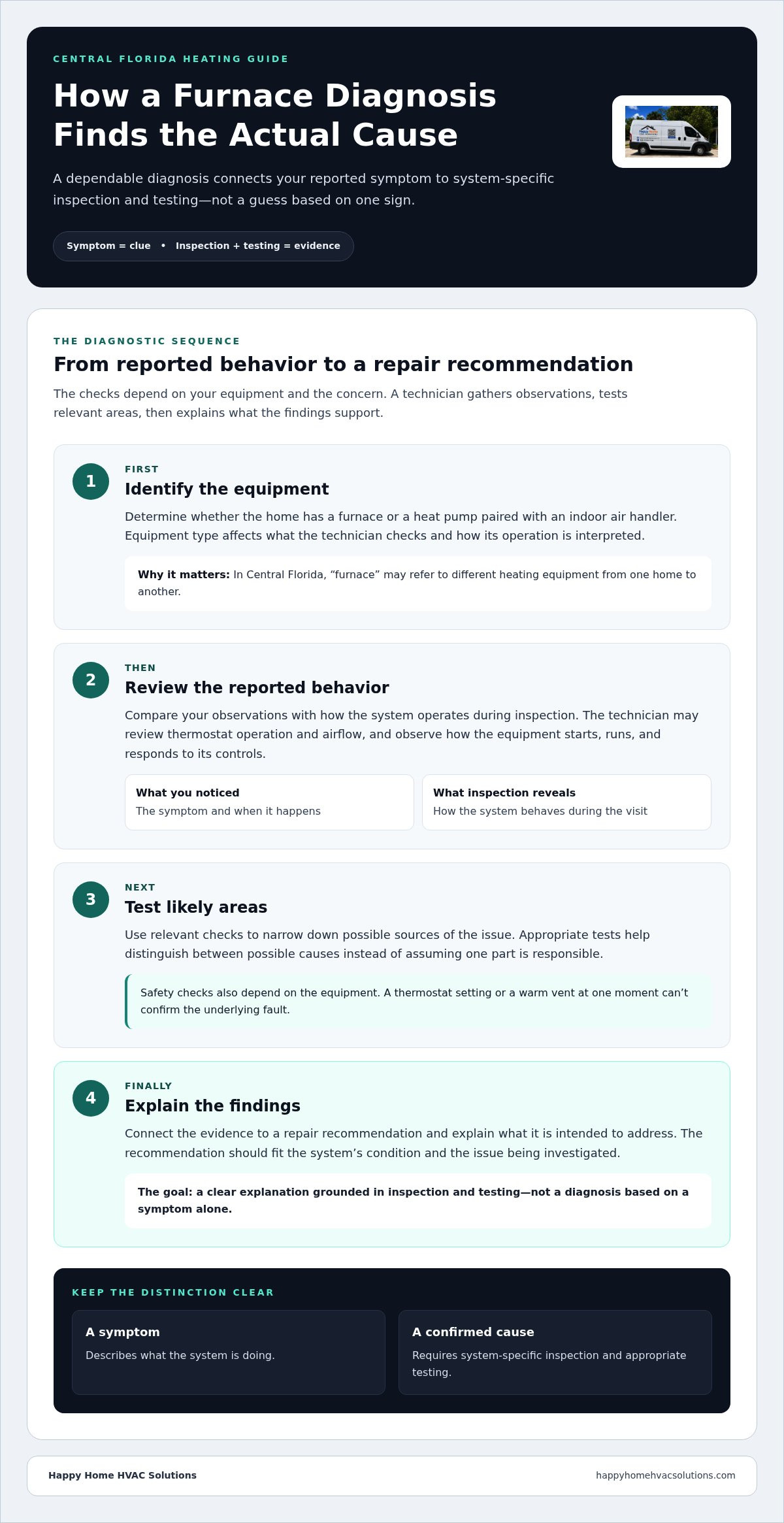
A dependable diagnosis is a process, not a guess based on one symptom. The technician first identifies the heating equipment and asks what you have noticed. Inspection and appropriate testing then help narrow down possible causes. The findings should lead to a clear explanation and a repair recommendation suited to the system’s condition.
That first step matters in Central Florida, where “furnace” may mean different equipment from one home to another. A traditional furnace generates heat, while a heat pump moves heat and may work with an indoor air handler. The equipment type affects what a technician checks and how they interpret its operation. A thermostat setting or a warm vent at one moment can’t confirm the underlying fault.
A symptom describes what the system is doing; only inspection and testing can confirm what has failed. A methodical approach to furnace repair Central Florida homeowners need connects the reported problem to evidence before a repair is recommended.
What happens during a professional furnace inspection?
The checks depend on the system and reported concern. A technician may review thermostat operation and airflow, then observe how the equipment starts, runs, and responds to its controls. Relevant safety checks also depend on the equipment. The goal is to gather system-specific observations and use appropriate tests to distinguish between possible causes rather than assume a single part is responsible.
- Identify the equipment: Determine whether the home has a furnace or a heat pump and air handler.
- Review the reported behavior: Compare your observations with how the system operates during inspection.
- Test likely areas: Use relevant checks to narrow down possible sources of the issue.
- Explain the findings: Connect the evidence to a repair recommendation and explain what it is intended to address.
For broader background, the U.S. Department of Energy’s information on consumer furnace regulations and standards can help homeowners understand the context around furnace equipment. It doesn’t replace a system-specific diagnosis, which depends on the equipment in your home and the issue being investigated.
What information helps the technician diagnose the issue?
A concise record makes the conversation more useful. Note the thermostat setting, what the system did, when the behavior began, and whether it happens every cycle or only sometimes. Share recent changes, such as a thermostat adjustment or a period when the home was unoccupied. If you know the equipment’s age, repair history, or recurring concerns, include those details too.
Don’t open equipment or attempt electrical or gas repairs to collect more information. A few clear observations are enough to give the technician a starting point. For another preparation and safety reference, see the Central Florida furnace repair and safety checklist.
Happy Home HVAC Solutions provides local HVAC service in Orlando. Learn more about local HVAC service in Orlando.
Furnace Repair or Replacement: How to Weigh the Recommendation
After a diagnosis, the next question is whether a repair can restore dependable operation or replacement better fits the equipment’s condition and your household’s needs. Neither option is automatically right. A recurring issue deserves attention, but it doesn’t prove the entire system should be replaced. The recommendation should connect the confirmed fault to the overall state of the equipment and explain why the proposed path makes sense.
Before deciding, make sure you understand what was found, what the repair is intended to address, and what concerns would remain afterward. For furnace repair Central Florida homeowners should receive a clear explanation grounded in the actual system, not a universal age cutoff or rule of thumb.
Which factors shape a repair-versus-replacement decision?
Consider the confirmed fault alongside the equipment’s repair history and overall condition. A clearly identified, isolated problem may support repair, while repeated failures or concerns affecting several parts of the system can make replacement worth discussing. Household needs matter too: how consistently the home needs heat, how reliable the equipment must be, and whether you expect your heating needs to change.
Condition: Repair may suit equipment with a limited, clearly identified issue. Replacement may merit consideration if the diagnosis points to broader deterioration.
Recurrence: A one-time concern differs from a pattern of repeated breakdowns. Ask how the current fault relates to earlier problems.
Reliability: Consider whether the recommended repair is expected to address the source of the disruption and what uncertainty remains.
Future needs: Weigh how long you plan to stay in the home and what level of dependable heating your household expects.
This comparison isn’t a scoring system. Use it to organize the discussion and understand the tradeoffs. A repeated problem can change the recommendation, but repair may still be appropriate if the technician’s findings support it. Replacement should likewise be explained through the system’s condition and your needs, not presented as the automatic answer to a single fault.
How should homeowners understand warranty considerations?
Equipment warranties and coverage for repair work are separate matters. Warranty terms can vary with the system and installation, so review the documents for the specific equipment rather than assuming all parts or work are covered. Happy Home HVAC Solutions offers up to a 12-year warranty on many installations. That does not mean furnace repairs are covered or that every installation has the same terms.
For more context about installation coverage, the Florida HVAC warranty guide explains why warranty details belong in the decision. Keep the equipment paperwork available and ask for the diagnosis and recommendation to be explained in plain language. That makes it easier to compare options and choose the path that best supports lasting comfort.
Preparing for Furnace Repair in Orlando and Nearby Communities
In Central Florida, heating may sit unused for long stretches, then become important during a cold spell. That intermittent use can make it harder to remember how the system normally sounds or behaves. A change may only become noticeable when you turn on the heat again. A little preparation helps you describe what’s happening and gives the technician a clearer starting point, without requiring you to inspect internal parts or attempt a repair.
What can homeowners safely do before a service visit?
Keep your preparation simple and focused on observations. Check that the thermostat is set to heat and note the temperature setting. If a message or alert appears, write it down or take a photo so you can share the exact wording. Don’t remove panels to look for a cause, and don’t attempt work involving wiring, gas, or internal components.
Make the area around the equipment accessible so it can be inspected. Move stored items or household clutter away from the unit without touching or rearranging its connections. Then jot down a few details:
- What the system does when you call for heat, including whether it starts, stops, or seems to run without warming the home.
- When the behavior began and whether it happens every time or only intermittently.
- Any noticeable change in airflow, sound, or comfort from room to room.
- Recent thermostat adjustments or other changes in how the system has been used.
Even a brief note such as “heat stopped after running for a short time” is more useful than trying to name a failed part. If the problem comes and goes, include both the times it occurs and the times the system seems to work normally. That pattern can help the technician understand the issue in context.
How does Central Florida’s seasonal heating use affect preparation?
Heating systems in the region may run less regularly than cooling equipment, so homeowners may have fewer chances to notice a developing change during routine use. There’s no need to assume a problem before one appears. Pay attention the first few times you use the heat each season. Notice whether the system responds as expected and whether comfort feels consistent across the home.
This local awareness matters for households in Orlando, Lake Mary, Sanford, Oviedo, Winter Springs, Winter Park, and Altamonte Springs. Happy Home HVAC Solutions serves homeowners across Central Florida. Orlando homeowners can find details about the local service area and coverage relevant to their home.
With your observations ready and the equipment area accessible, you’ll be better prepared to explain the concern and understand what the inspection finds. Explore local HVAC services from Happy Home HVAC Solutions, including furnace repair Central Florida homeowners can rely on to address heating problems and restore home comfort.
Get Local Furnace Repair from a Licensed Central Florida HVAC Company
Once you understand what your system is doing and why a diagnosis matters, the next step is working with a local team that can explain the findings clearly. Happy Home HVAC Solutions is a family-owned, licensed HVAC company serving Central Florida, including Orlando and nearby communities. The company provides heating and furnace services to address diagnosed system problems and help restore comfort and dependable heat at home.
A good repair conversation should leave you better informed, not more uncertain. The recommendation should connect the system condition to the issue identified during diagnosis. You should be able to understand what work is proposed and how it relates to the problem. That clear connection helps you weigh your options without feeling rushed into a decision.
What should homeowners expect from a clear repair conversation?
Expect a plain-language explanation of the findings, the recommended work, and any relevant options. If the diagnosis identifies a specific fault, the explanation should clarify how it affects operation and what the proposed repair is meant to address. If other concerns are present, they should be distinguished from the immediate issue so you can understand the full picture.
For furnace repair Central Florida homeowners can approach with confidence, clarity matters at each step: what was observed, what the recommendation addresses, and what decision comes next. You don’t need to know technical terminology to ask for an explanation that makes sense. A straightforward conversation can help you feel informed before moving ahead.
When is it time to arrange professional furnace service?
Arrange service when a heating concern persists, returns after seeming to resolve, or makes it difficult to rely on your system for home comfort. A brief change in comfort may not tell the whole story, but repeated interruptions or a system that no longer provides dependable heat deserve professional attention. Share when the issue occurs and how often; those details can help make the visit more productive.
Safety concerns require a different response from routine repair scheduling. If you suspect a gas leak or someone may be experiencing carbon monoxide symptoms, leave the area and seek emergency help. Don’t operate equipment that appears unsafe or has an active safety warning.
Happy Home HVAC Solutions serves homeowners in Orlando, Lake Mary, Sanford, Oviedo, Winter Springs, Winter Park, Altamonte Springs, and other Central Florida communities. If your home also has a separate cooling-system issue, the company provides air-conditioning repair. That service is distinct from furnace repair and isn’t a substitute for addressing a heating problem.
When you’re ready, request furnace service through Happy Home HVAC Solutions’ HVAC services page. A clear explanation and a diagnosis-based recommendation can help you move toward dependable heat with greater peace of mind.
Take the Next Step Toward Steady Comfort
A comfortable home is easier to enjoy when heating concerns don’t linger in the background. Treat a change in performance as a useful cue to take action rather than waiting for another cold spell to reveal the same problem. A clear service conversation can help you move from uncertainty to a practical plan for your home.
For furnace repair Central Florida homeowners can approach with confidence, put the condition of your equipment first. Happy Home HVAC Solutions is a family-owned, licensed HVAC company serving Central Florida, with heating and furnace services to help restore home comfort. Share what you’ve noticed and get the process started without trying to diagnose the system yourself.
Request furnace service from Happy Home HVAC Solutions and take a straightforward step toward dependable heat. A little clarity now can help make your home feel welcoming when cooler weather returns.
Frequently Asked Questions
These answers offer practical guidance for homeowners in Orlando, Oviedo, Winter Springs, Winter Park, and Altamonte Springs who want to make informed decisions about home heating.
How much does furnace repair cost in Central Florida?
Furnace repair costs depend on the diagnosed problem, the equipment, and the work needed. A thermostat-related issue and a repair involving an internal system component can require different labor and parts. For furnace repair Central Florida homeowners should base their decision on the specific findings, not a generic estimate. A written estimate can show which work is recommended and distinguish it from optional improvements.
How long does a furnace repair appointment take?
Appointment length varies with the system and the issue being investigated, so there isn’t one reliable duration for every repair. Time may be needed to identify the equipment, reproduce an intermittent problem, complete relevant checks, and explain the findings. If a repair is approved, the work involved also affects the visit. Keep your schedule flexible and share any time-sensitive household needs when arranging service.
Can a thermostat problem make a furnace stop heating?
Yes, a thermostat issue can prevent a heating system from responding as expected. It may be set to the wrong mode, have a blank display, or fail to communicate properly with the equipment. If the display is blank, check the thermostat’s instructions to see whether its batteries are replaceable. A thermostat symptom doesn’t prove the thermostat is the cause, so note what the display shows and whether settings change.
What should I do if I smell gas near my furnace?
Leave the building immediately if you suspect a gas leak, and call emergency services from a safe location. Don’t use electrical switches, operate the furnace, or try to find the source of the smell. Keep others away from the area. Don’t return until emergency responders say it’s safe. A suspected gas leak is an immediate safety issue, not a routine furnace service appointment.
Does homeowners insurance cover furnace repairs?
It depends on your policy and what caused the damage. Coverage may differ between a sudden event and a breakdown related to age, wear, or maintenance, and exclusions or deductibles may apply. Review your policy wording and contact your insurer to understand how a claim would be handled. If you’re considering a claim, clarify any approval requirements before authorizing repair work.
Can a heat pump provide heat instead of a furnace in Central Florida?
Yes, a heat pump can heat a home by moving heat from outdoor air indoors. Many Florida homes use a heat pump with an indoor air handler, sometimes with electric heat strips for backup heating. This setup works differently from a fuel-burning furnace, even though homeowners may casually call the indoor equipment a furnace. If you’re unsure what your home has, check the system’s labels or paperwork.
Should I turn off my furnace if it keeps shutting down?
If the system repeatedly shuts down, stop restarting it over and over. Use the normal thermostat control to turn heating off and arrange professional service, especially if the shutdowns continue or a safety warning appears. Repeated cycling can signal a problem that needs assessment, but it doesn’t identify the cause by itself. If you smell gas or suspect another immediate danger, leave the area and seek emergency help.