
Air filter replacement for your home
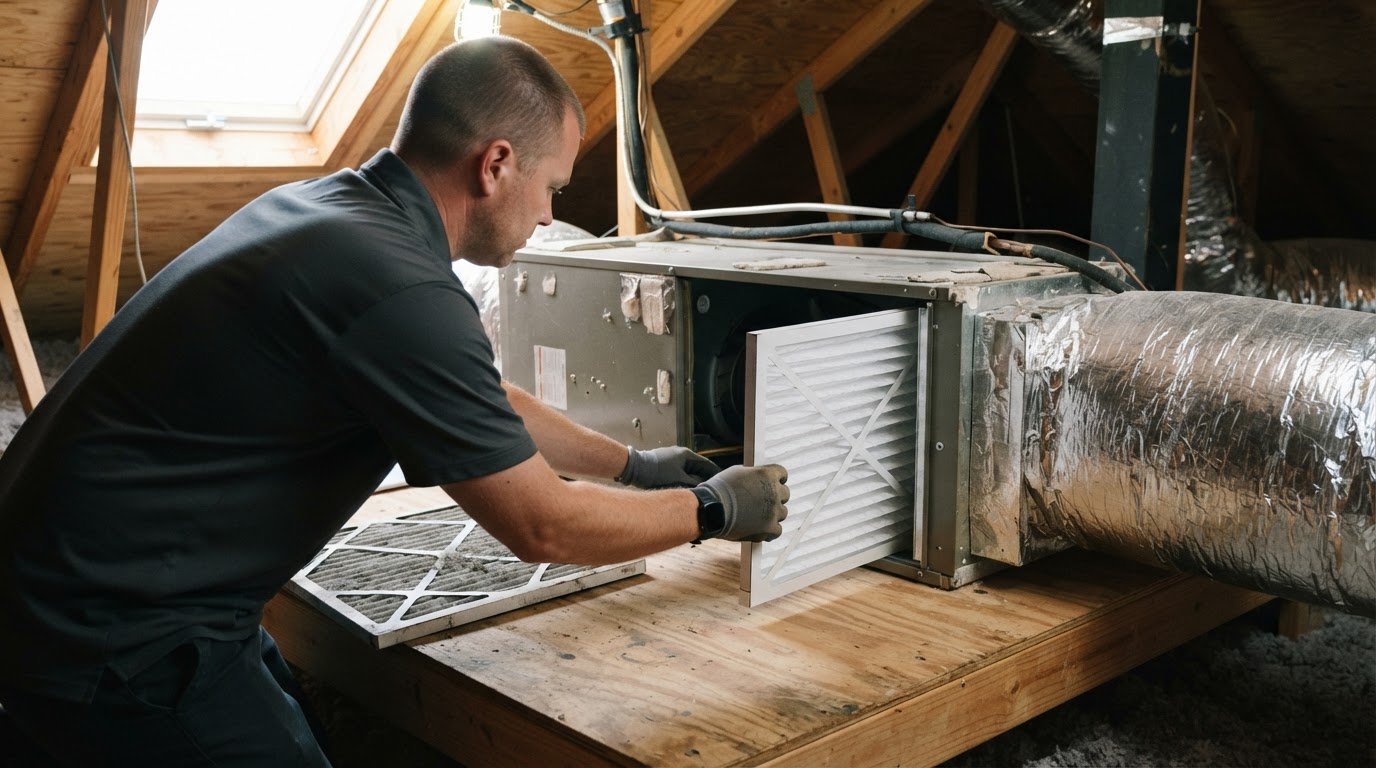
The right air filter replacement involves more than swapping one filter for another. A professional identifies the size and type your HVAC system needs, removes the used filter, installs a compatible replacement in the correct direction, and checks that it fits securely.
A straightforward fix is appealing, especially when dust, pet hair, smoke, or allergy concerns make you think about what your system is filtering. But a filter that doesn’t suit the equipment may be the wrong choice, even if it looks more efficient on paper.
This guide explains how professionals handle replacement, what they look at when choosing a filter, and how MERV ratings relate to particle capture and system compatibility. You’ll also learn what can affect the work and when a filter issue may point to a wider HVAC concern. With a clearer picture of the process, you can make informed choices for your home and feel more at ease about your system.
Key Takeaways
- Choose a filter with your household’s allergy, pet, and smoke concerns in mind, while keeping your HVAC system’s needs central.
- Learn what a MERV rating tells you about particle capture and why a higher rating isn’t automatically the best fit.
- Understand what a professional considers when recommending a replacement, cleaning a reusable filter, or addressing a wider HVAC concern.
- Recognize how restricted airflow from a dirty filter can affect system operation and what signs may call for professional attention.
- See when HVAC service can help if filter changes aren’t resolving comfort or airflow problems.
How HVAC professionals choose filters for allergies, pets, and smoke
Professionals start with the HVAC system, not just the household concern. They identify the filter slot’s dimensions, the current filter type, and the equipment’s airflow requirements. A replacement must fit the rack without gaps or excessive resistance. That matters whether your home has seasonal allergies, shedding pets, or smoke exposure. The right choice balances particle capture with the system’s ability to move air.
Next, they clarify what the filter needs to address. Pollen and other airborne particles differ from pet hair, which often settles on surfaces and collects on larger filter fibers. Smoke can leave fine particles and lingering odors, so professionals distinguish particle filtration from odor control. A filter designed to capture particles may not address odors in the same way. This helps avoid choosing based on a broad product label alone.
- For allergies: Professionals consider which airborne particles matter and compare filter ratings with system compatibility.
- For pets: They account for airborne dander and fur, while recognizing that filters don’t remove hair already settled on furniture.
- For smoke: They consider fine-particle capture and whether a filter includes an odor-control feature, such as carbon media.
Product names can sound specific, but they don’t replace technical details. “SmokeBlock” and “AllergenBlock” are examples of labels a homeowner might encounter. Professionals look beyond the names to the filter’s stated rating, construction, dimensions, and compatibility. A label alone doesn’t show whether a filter will fit or suit a particular system. They also distinguish a filter’s stated purpose from what it can reasonably address throughout a home.
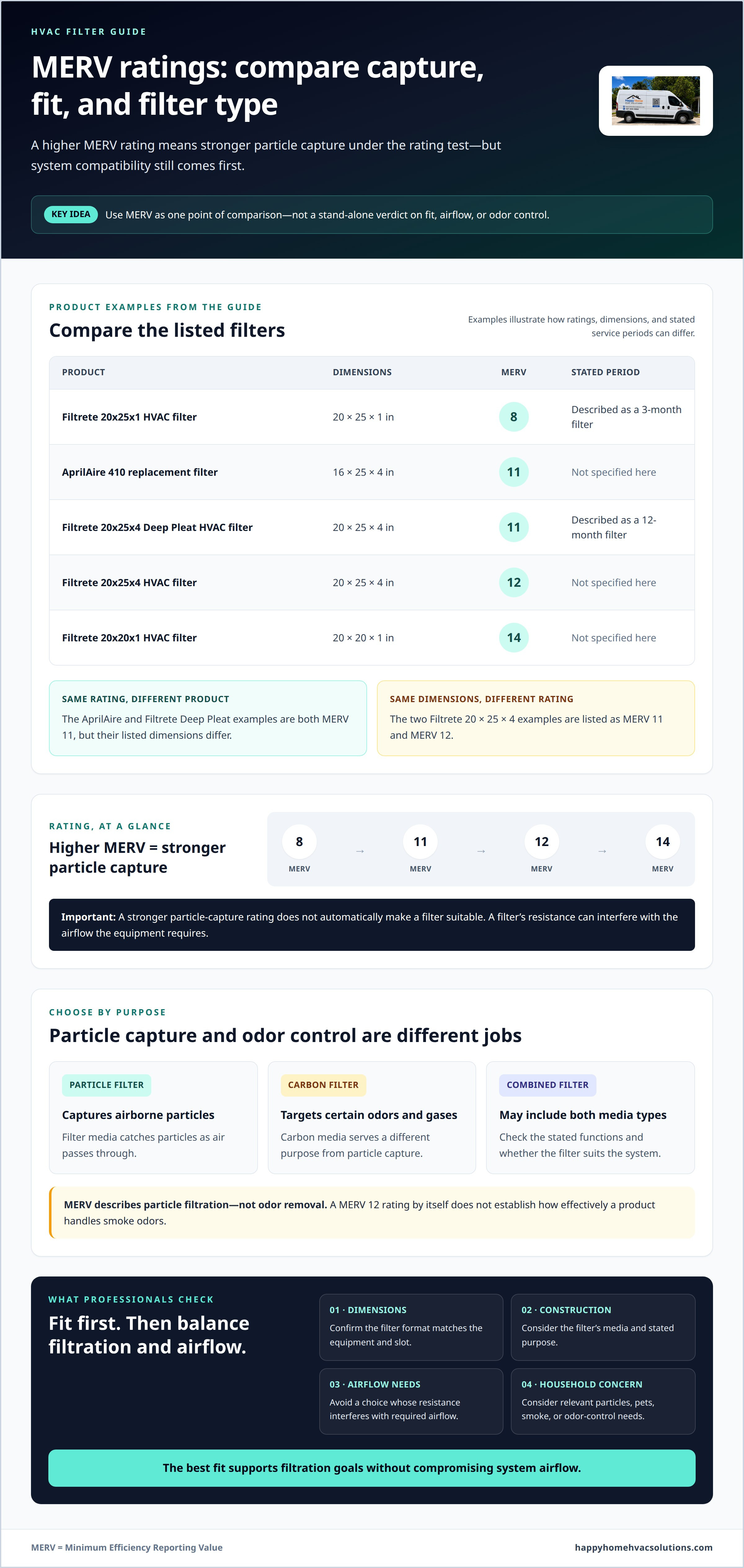
One example is a Filtrete 20x25x1 HVAC filter rated MERV 8 and described as a 3-month filter. That example illustrates why size and rating both matter. It isn’t a universal recommendation: the system’s requirements still guide selection. A professional can also explain how the chosen filter fits the household’s needs and maintenance routine.
During an air filter replacement, the technician can compare the existing filter’s markings with the equipment requirements and discuss concerns such as pets or smoke. If you want context on the replacement process, AC filter replacement guidance covers related considerations. The goal is a compatible filter choice, not simply the highest rating or the most persuasive product name.
MERV ratings and particle capture
MERV means Minimum Efficiency Reporting Value, a rating used to compare air filters. A higher MERV number indicates stronger particle capture under the rating test, but it doesn’t automatically make a filter right for every HVAC system. Professionals weigh the rating alongside filter dimensions and equipment airflow needs. A filter that captures more particles can still be unsuitable if its resistance interferes with the system’s required airflow.
Consider three listed examples. An AprilAire 410 replacement filter is rated MERV 11 and measures 16x25x4 inches. A Filtrete 20x25x4 Deep Pleat HVAC filter is rated MERV 11 and described as a 12-month filter. A Filtrete 20x25x4 HVAC filter is rated MERV 12. These examples show that identical MERV ratings can appear in different products, while the same dimensions can have different ratings.
A Filtrete 20x20x1 HVAC filter is rated MERV 14. That rating alone doesn’t establish compatibility with a particular furnace or air conditioner. During selection, a professional compares the equipment’s requirements with the filter’s size, construction, and rating. The best fit is the one that supports the household’s filtration goals without compromising the system’s airflow.
- Particle filters use filter media to capture airborne particles as air passes through.
- Carbon filters use carbon media to help address certain odors and gases; they serve a different purpose from particle capture.
- Combined filters may include both types of media, so professionals consider their stated functions and system compatibility.
These distinctions matter for smoke. A particle filter can capture some airborne particles, while carbon media targets odors through a different mechanism. A MERV rating describes particle filtration, not odor removal. For example, choosing a MERV 12 filter doesn’t by itself establish how effectively a product handles smoke odors. The product’s construction and the HVAC system’s requirements both matter.
Filter depth can also shape the choice. The AprilAire 410 example measures 16x25x4 inches, while the Filtrete example measures 20x25x4. Those dimensions describe specific products, not universal slots. A professional confirms that the filter format matches the equipment before recommending a higher rating. This prevents a number on the label from outweighing practical fit and airflow considerations.
Use MERV as one point of comparison, not a stand-alone verdict. Professionals consider the rating alongside the particles of concern, filter media, and equipment design. This helps them assess an allergy-related choice, smoke concerns, or routine household dust without assuming one filter can solve every indoor air issue.
How do HVAC professionals replace an air filter?
A professional replacement starts with the system, not a guessed filter size. The technician identifies the unit and filter location, then examines the existing filter and its frame. For example, a central air handler may use a return-side filter, while another system has a dedicated slot. The equipment design and filter location determine the next steps.
Next, the technician records the filter dimensions and checks the fit. Gaps can let unfiltered air pass around the edges, while a poorly fitting filter may shift during operation. The technician compares the filter’s markings and physical size with the system’s requirements before selecting a replacement. This avoids relying on a package label alone.
Then comes the filter choice. The technician considers the compatible filter type, household concerns, and replacement construction. A pleated filter, for example, differs from a basic panel in design and filtration properties. The MERV rating can inform the choice, but it doesn’t override equipment requirements. The professional explains why the selected option suits the system.
- Inspect: Locate the filter, assess its condition, and note its dimensions and orientation.
- Select: Match the replacement type and size to the HVAC equipment.
- Replace: Remove the used filter and install the compatible one in the proper airflow direction.
- Confirm: Check that the new filter sits securely and the access panel is correctly closed.
After installation, the technician checks that the filter sits evenly and doesn’t obstruct the compartment. An airflow-direction arrow helps establish orientation, but the system’s design guides placement. The professional can also note the filter type installed, making future maintenance discussions clearer. If airflow or comfort concerns remain, the system may need attention beyond the filter.
The cost depends on the work involved and is provided after a quote request. Factors include the replacement filter type, access to its location, and whether an inspection identifies related work. A straightforward filter change differs from a visit that also involves diagnosing an airflow problem. Filter dimensions and construction can affect the replacement selected, so there isn’t one price for every system and service scope.
For a useful maintenance context, AC filter replacement timing in Florida explains why household conditions and system use matter. A technician can document the installed filter and explain what conditions could bring forward its next replacement. That gives the homeowner a practical reference without treating one schedule as right for every system.
Professional air filter replacement and cleaning
No, washable filters aren’t automatically better than disposable filters. The suitable option depends on the HVAC system, the filter’s design, and whether its cleaning and maintenance requirements fit the household.
Washable and Disposable Filter Comparison
A washable filter can be cleaned and reused, while a disposable filter is replaced when it needs changing. Professionals consider whether the system accepts that type, how it should be cleaned, and whether it can be fully dried before reuse. A washable label alone doesn’t establish that a filter suits a particular furnace or air conditioner.
Disposable filters simplify the routine: discard the used filter and install a compatible replacement. Washable models require recurring cleaning and careful reinstallation. For either style, a professional considers fit, construction, and manufacturer instructions. A filter that’s still damp or seated incorrectly isn’t ready to return to service.
Dirty Filters and HVAC Systems
A dirty filter can restrict airflow through an HVAC system. The blower may have to work harder to move air, and reduced airflow can affect heating or cooling performance. For example, weak airflow at a vent alongside a visibly loaded filter gives a technician reason to inspect both the filter and system operation.
A clogged filter may contribute to higher energy use, but it isn’t the only possible cause of a higher bill. A technician considers the filter’s condition alongside airflow, equipment performance, and household comfort. If a fresh, correctly fitted filter doesn’t resolve the concern, the system may need a broader diagnosis.
Cleaning isn’t appropriate for every filter. Clean a reusable model according to its manufacturer’s instructions; replace a disposable model rather than washing it. The technician identifies the type installed before recommending either action. This avoids treating a disposable filter like a washable one or reinstalling a reusable filter before it’s clean and dry.
During a professional visit, the technician can inspect the filter and housing, then look for signs that airflow remains restricted. Dust around the filter edges, a loose fit, or a bowed filter can point to installation or compatibility issues. These observations help distinguish a filter problem from a separate equipment concern.
For a reusable filter, follow the product’s specific instructions rather than a universal cleaning method. Water, cleaning products, and drying requirements vary by design. A technician can explain how to maintain the installed model. If its instructions call for replacement, cleaning won’t restore it.
Keep the decision practical: disposable filters follow a replace-and-discard routine, while washable filters require ongoing care. Either can be a poor choice if it doesn’t fit the equipment or meet its requirements. A professional evaluates the installed filter, system, and any persistent airflow or comfort symptoms before recommending the next step.
Can a dirty air filter damage an HVAC system or increase energy bills?
A dirty filter restricts airflow through an HVAC system. The blower then moves air against greater resistance, and heating or cooling may become less effective. For example, weak airflow from several supply vents alongside a visibly clogged filter gives a technician reason to inspect the filter and system together.
Restricted airflow can also affect how long equipment runs. If the thermostat calls for cooling but less air circulates through the home, the system may run longer to reach the set temperature, using more energy. A rising bill alone doesn’t prove the filter is responsible, but a technician can assess whether it’s clogged.
Persistent airflow restriction can place additional strain on HVAC components. In a cooling system, reduced airflow across the indoor coil can interfere with normal operation. In a furnace, poor circulation can affect heat distribution. A technician evaluates the filter alongside equipment behavior rather than assuming every comfort problem comes from dirt.
- Airflow: A technician compares weak vent output with the filter’s condition and fit.
- Comfort: Uneven room temperatures can indicate airflow or equipment concerns.
- Runtime: Longer cycles can point to restricted airflow or another operating issue.
- System condition: Continued symptoms after a fresh filter call for broader diagnosis.
A professional air filter replacement can restore a clear path for airflow when the filter is the problem. If a clean, compatible filter doesn’t improve weak airflow, the technician can examine other causes. A blocked return, duct issue, or equipment fault requires a different response. Replacing filters repeatedly without investigating persistent symptoms can leave the underlying problem unresolved.
Energy use depends on more than the filter. Thermostat settings, system condition, and airflow through the home all influence operation. A clean filter, for instance, won’t resolve uneven cooling caused by a separate equipment issue. A technician weighs these signs together before linking a higher bill to restricted airflow.
During service, the technician can document the filter’s condition, inspect its seating, and assess how the system operates afterward. That comparison helps distinguish a filter-related change from an ongoing concern. If the system still struggles to heat, a furnace performance issue may need separate attention.
If weak airflow or longer system cycles continue, schedule an HVAC service visit to have the equipment assessed.
Happy Home HVAC Solutions
Happy Home HVAC Solutions can help when filter concerns point to a wider HVAC issue in Orlando, Oviedo, Winter Springs, Winter Park, or Altamonte Springs. If airflow stays weak after installing a compatible filter, or rooms remain uncomfortable, a professional assessment can help identify whether the system needs attention. The team provides AC Repair, AC Installation, Heating & Furnace Services, and Insulation Services for related comfort and equipment concerns. A filter alone won’t resolve every cause of poor airflow or uneven temperatures, so persistent symptoms may call for a broader assessment. Contact Happy Home HVAC Solutions to discuss your HVAC concern.
Make your next HVAC decision with confidence
Your next air filter replacement is an opportunity to address more than the filter itself. If comfort problems persist, share what you’ve noticed, such as which rooms feel different or whether airflow changes during heating or cooling. Those details can help an HVAC professional understand the concern and decide what to assess.
There’s no need to guess based on a filter label alone. A system that continues to struggle may need a closer look, while a filter concern may be straightforward. The important step is matching the response to what your home and equipment are telling you.
Happy Home HVAC Solutions can help you consider the right next step for your home’s comfort. If you’re ready to discuss a filter or HVAC concern, contact Happy Home HVAC Solutions. A clear conversation can make the path forward feel manageable.
Frequently Asked Questions
How does a professional change an air filter?
A professional identifies the filter location, removes the existing filter, and installs a compatible replacement. They also confirm the airflow direction and check that the filter sits securely in its track. An unusually dirty or damaged filter can help the technician understand the system’s condition. The professional may document the filter model so future service can refer to the correct replacement.
Are air filters and furnace filters the same thing?
“Furnace filter” often describes the air filter used by a forced-air heating system, while “air filter” is a broader term. In a home with shared heating and cooling equipment, the same filter may serve both. However, some homes have separate equipment or filter locations. A technician can identify which filter serves each unit, especially in homes with additions or multiple HVAC systems.
Can I use the same air filter for both heat and AC?
One filter often serves both heating and cooling when they use the same air handler and ductwork. It captures airborne particles as air circulates through the shared system, whether the system is heating or cooling. Separate systems may have separate filters. A technician can confirm the setup by tracing the equipment and checking manufacturer requirements before recommending a filter.
How does an HVAC professional determine what air filter size I need?
A professional checks the filter compartment and equipment documentation, then compares those details with the existing filter. If its label is missing or unreadable, the technician can measure the slot and check its depth. They also check how the filter sits in the frame, since a loose fit can let air bypass it. The dimensions must match the actual housing.
How often should I replace my home HVAC air filter?
Follow the replacement interval recommended for the filter and HVAC system, then consider how quickly the filter collects debris. Pets, dust from home projects, and frequent system operation can affect how soon it needs attention. For example, a filter in a home with a shedding dog may load differently from one in a home without pets. A technician can help set a schedule based on observed conditions.
How does an HVAC professional determine what air filter size to install?
The technician confirms the equipment’s filter opening and whether it accepts a standard or deeper filter format. They compare the opening with the filter’s labeled dimensions and check that the frame holds it firmly. This also matters after equipment changes: a replacement unit may have a different filter cabinet from the previous one. The technician bases the installed size on the current system, not assumptions.
How does an HVAC professional find the correct air filter size and type for my HVAC system?
A professional evaluates the filter housing, system documentation, and existing filter, then selects a replacement that meets the equipment’s requirements. They also consider household filtration priorities, such as dust or pet-related concerns, without choosing a type that conflicts with the system. In a home with more than one unit, the technician identifies each filter location separately because the systems may use different formats.
What MERV rating should an HVAC professional recommend for my home air filter?
The recommended MERV rating depends on the HVAC system’s requirements and the household’s filtration goals. A technician considers whether the equipment can accommodate the filter’s airflow resistance, then weighs concerns such as airborne particles or household dust. A higher rating isn’t automatically right for every system. The professional should match the rating to the equipment and explain the reasoning behind the recommendation.